
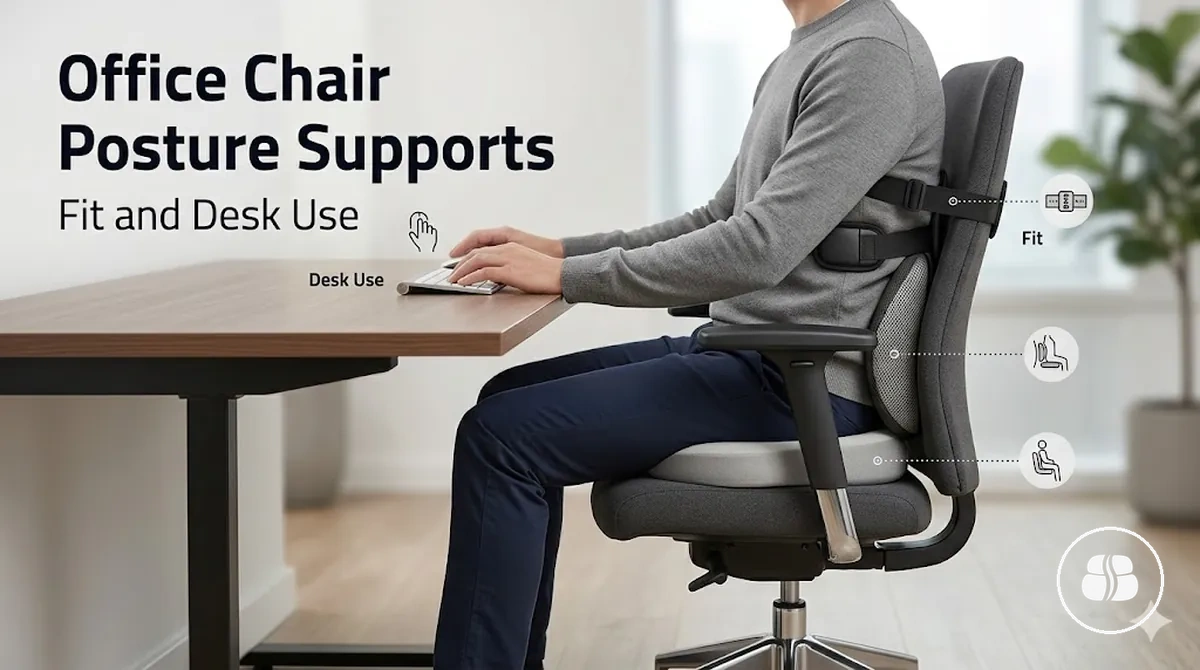
Posture support accessories for office chair compatibility
Posture support accessories for office chair compatibility is determined by how an accessory aligns with office chair design, backrest shape, lumbar contact, seat space, and attachment stability during desk use. This condition defines whether the support maintains correct positioning on the chair, reaches the intended body area, and remains stable during normal sitting movement in a desk work environment.
Compatibility is shaped by the relationship between chair structure and accessory design, including backrest curvature, lumbar contact zone, seat depth, cushion thickness, armrest clearance, and recline behavior. Attachment method and strap security influence whether the support stays fixed or shifts during use, while desk use patterns such as long sitting or frequent movement can change stability and comfort outcomes. In many cases, the same accessory may behave differently depending on how these conditions interact.
For example, a lumbar cushion may align more predictably with a flat office chair backrest because the contact area is consistent, while it may sit unevenly on a contoured mesh chair with built-in lumbar shaping. Strap-based attachments may hold firmly on rigid chair frames but can shift on flexible or curved backs. This creates a practical boundary where compatibility depends on chair geometry, attachment behavior, and desk use conditions working together rather than a single fixed fit rule.
What office-chair compatibility means for posture support accessories
Office-chair compatibility for posture support accessories is the condition where a posture support accessory aligns with an office chair feature, supports correct backrest interaction, and matches the desk-use posture need. It defines how the accessory connects with lumbar contact, seat space, and chair structure to create usable comfort and stability during sitting. This compatibility frame determines the practical match between support design and chair behavior.
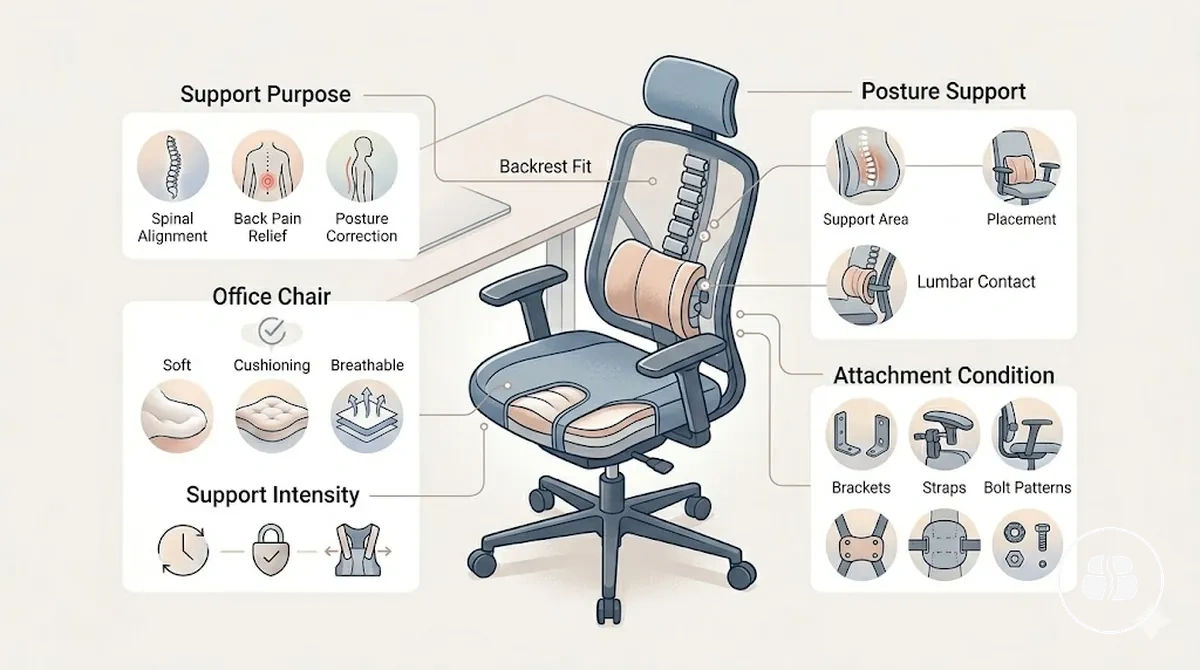
This condition chain typically moves from posture support accessories to a specific chair feature, then to attachment condition or backrest alignment, and finally to comfort and stability outcomes during desk use. Variations in chair design, such as mesh backs, rigid frames, or reclined structures, can change how the accessory behaves even when it appears compatible at a surface level. The practical implication is that compatibility should be evaluated through how the support interacts with real sitting pressure rather than appearance alone.
A lumbar support may align well with a straight office chair backrest but feel mispositioned on a deeply curved ergonomic chair due to altered lumbar contact points. In this case, the accessory remains structurally compatible, yet the user experience changes because of geometry and desk-use posture differences. Posture support accessories hub helps frame these variations across broader accessory types and their chair interactions.
Office chair features that affect posture support fit
Office chair features that affect posture support fit depend on how specific chair design elements interact with posture support accessories under desk use conditions. Backrest shape, lumbar contact area, seat space, and attachment condition together determine whether a support accessory can sit correctly and maintain stable positioning. This creates the main compatibility frame where chair structure defines posture support fit outcomes.
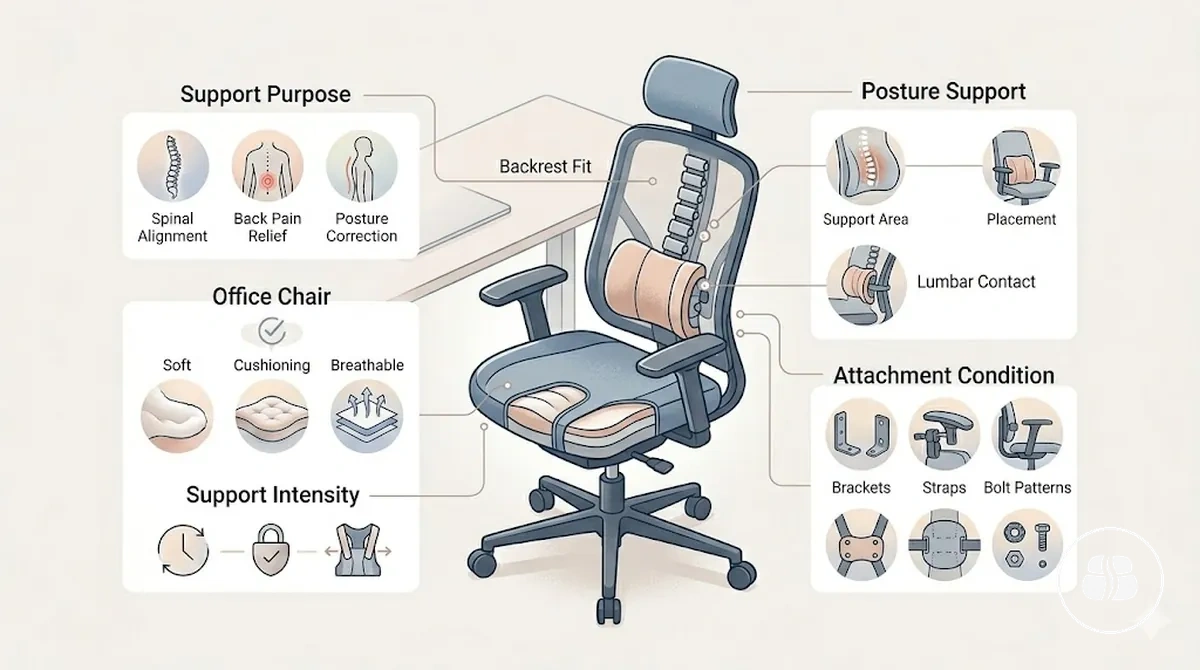
Fit conditions change across different chair parts such as the backrest, seat base, cushion space, armrests, and recline behavior, where each chair feature introduces a different constraint or support opportunity. A flat backrest may improve lumbar contact stability, while a curved or mesh structure may alter attachment condition and shift support alignment. Seat depth and cushion spacing influence how posture support accessories sit during desk use, which can affect both comfort and stability without changing the accessory itself. These relationships align with structural compatibility patterns described in section-level reference signals :contentReference[oaicite:0]{index=0}.
To organize these relationships clearly, the table below maps key office chair features to their fit conditions and resulting effects on posture support accessories. It helps separate structural constraints from usability outcomes in desk-use posture.
| Factor | Condition | Fit effect | Decision cue |
|---|---|---|---|
| Backrest | Flat or curved surface | Changes lumbar contact alignment | Check support positioning stability |
| Seat base | Depth and tilt range | Affects sitting balance and support reach | Match depth with seated posture |
| Cushion space | Available clearance | Limits accessory thickness fit | Ensure unobstructed placement |
| Armrests | Height and width spacing | Influences attachment clearance | Verify side movement freedom |
| Recline behavior | Fixed or adjustable angle | Shifts support contact during movement | Assess stability in active use |
Backrest height, shape, and lumbar contact
Backrest height, shape, and lumbar contact directly control posture support fit in an office chair because they define where support attachments align and how pressure is distributed during desk use. A higher or lower backrest changes the usable contact zone for lumbar cushions and strapped supports. This creates a compatibility condition based on alignment between backrest structure and attachment position.
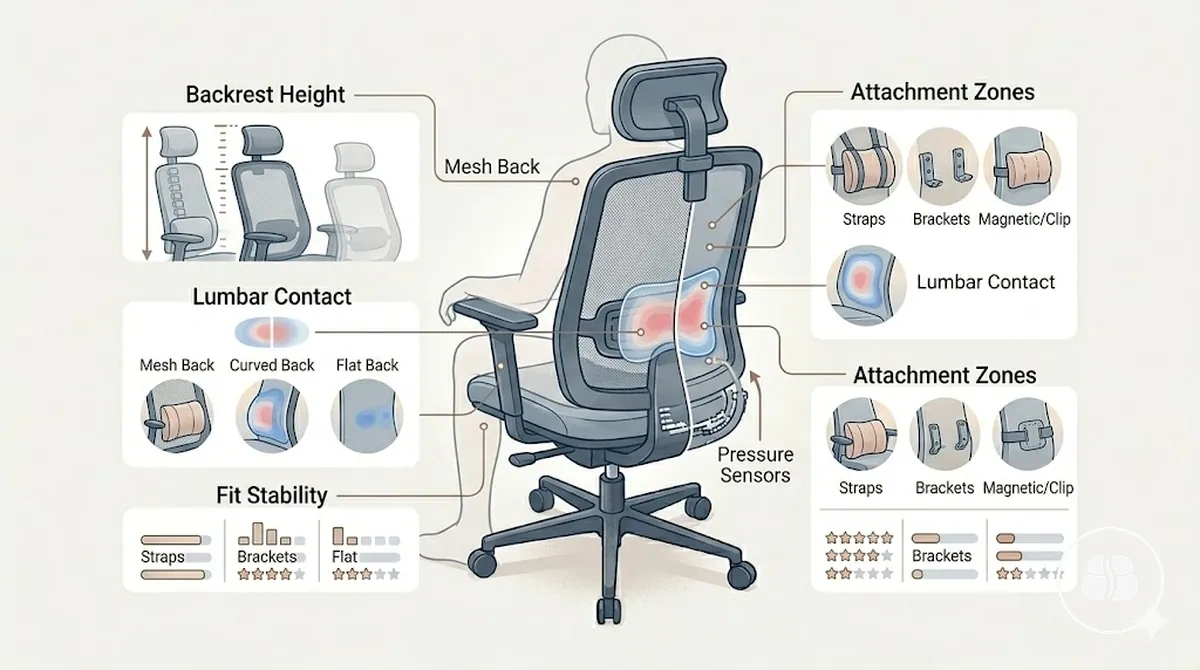
Backrest height determines whether the lumbar support sits too high, too low, or at a stable mid-zone, while curvature influences how naturally the support follows the lumbar contact area. Mesh tension and seat space can further affect posture support fit by changing how firmly the attachment holds against the surface and how the office chair structure supports positioning, which may increase or reduce slippage risk during desk use. In practice, flat backrests tend to offer more predictable lumbar contact, while curved and mesh designs require closer attention to attachment positioning, seat space constraints, and stability conditions during desk use.
Seat depth, cushion space, and armrest clearance
Seat depth, cushion space, and armrest clearance affect posture support fit in an office chair because they determine how much sitting room remains after adding cushions or support attachments during desk use. In smaller chairs, limited seat depth can reduce thigh clearance, while thicker cushions may push the user forward and reduce desk access. Armrest clearance further changes how freely a chair support attachment can sit without obstruction, creating a condition-based fit decision.
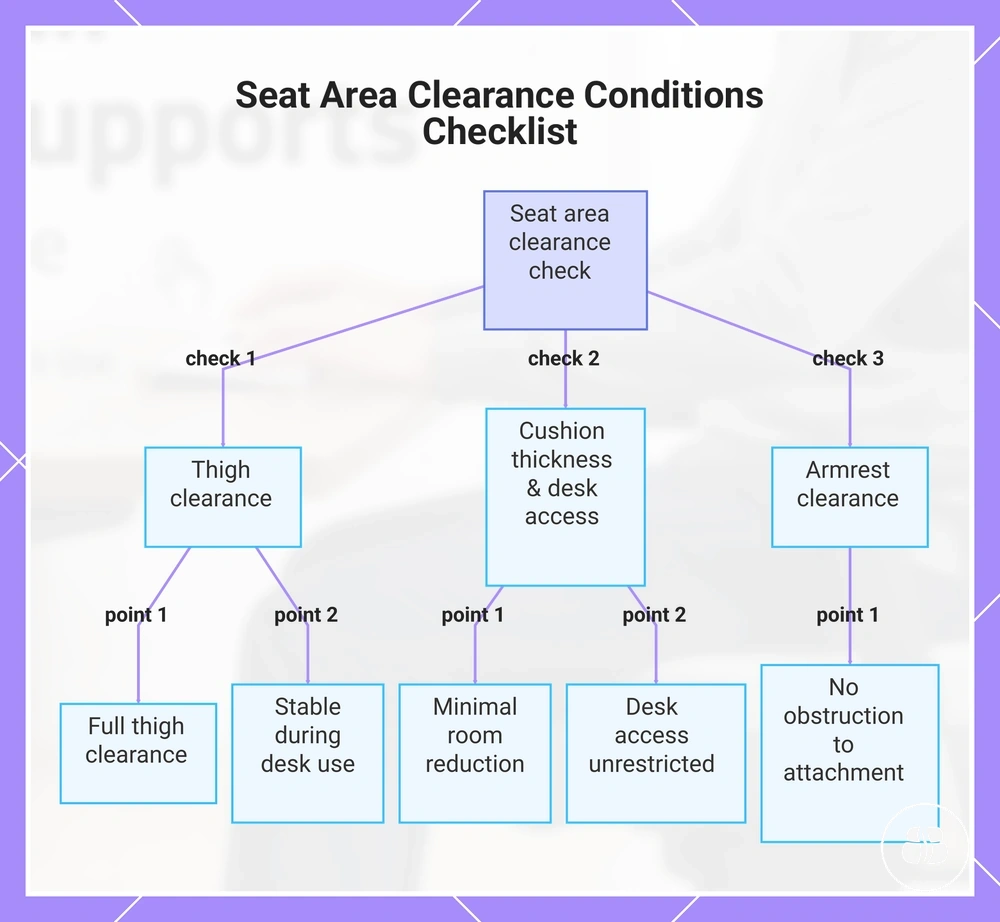
These factors determine whether the seat area maintains usable sitting room after adjustments during desk use. A quick check helps assess whether seat depth, cushion thickness, and armrest clearance work together without reducing thigh clearance or limiting desk access.
Checklist: Seat area clearance conditions
- Seat depth allows full thigh clearance without front-edge pressure
- Cushion thickness does not significantly reduce sitting room
- Armrest clearance does not block attachment placement
- Thigh clearance remains stable during normal desk use
- Desk access is not restricted by forward seating shift
This chart shows the key conditions to check when evaluating seat depth, cushion space, and armrest clearance for adding chair support attachments.
Accessory formats that work with office chairs
Accessory formats that work with office chairs depend on how each format interacts with placement, attachment behavior, and desk use conditions. The main decision frame is whether a lumbar cushion, seat cushion, chair attachment, strap system, or wearable posture corrector can maintain stable positioning without disrupting sitting posture or desk suitability.
Accessory formats differ in how they function with office chairs and what kind of support they emphasize. A lumbar cushion and seat cushion focus on direct seated support through placement on chair surfaces, while a chair attachment and strap rely on structural fixing to the chair frame or backrest. A wearable posture corrector works independently from the chair and instead influences body alignment, which may change how it fits into long desk use scenarios where chair-based support is preferred. These differences shape how each format responds to office-chair compatibility conditions.
The comparison below groups accessory formats by placement, attachment behavior, and desk suitability to clarify their functional differences.
| Format | Placement / Attachment | Office-chair condition | Use fit |
|---|---|---|---|
| Lumbar cushion | Backrest placement | Depends on stable contact with chair back | Seated lower-back support during desk use |
| Seat cushion | Seat surface placement | Alters sitting room and pressure distribution | Comfort adjustment for prolonged sitting |
| Chair attachment | Fixed to chair structure | Requires compatible frame or support points | Integrated back support during desk work |
| Strap system | Wrapped attachment | Depends on strap tension and chair shape | Variable stability in movement |
| Wearable posture corrector | Body-worn | Independent of chair structure | Posture cueing during sitting periods |
Lumbar pillows and lower-back support cushions
Lumbar pillows and lower-back support cushions depend on placement against the office chair backrest to shape how the lower-back contact zone is supported during desk use. Their behavior changes based on cushion height alignment with the lumbar area and how the chair backrest distributes pressure, which defines the main condition for stable placement and desk suitability.
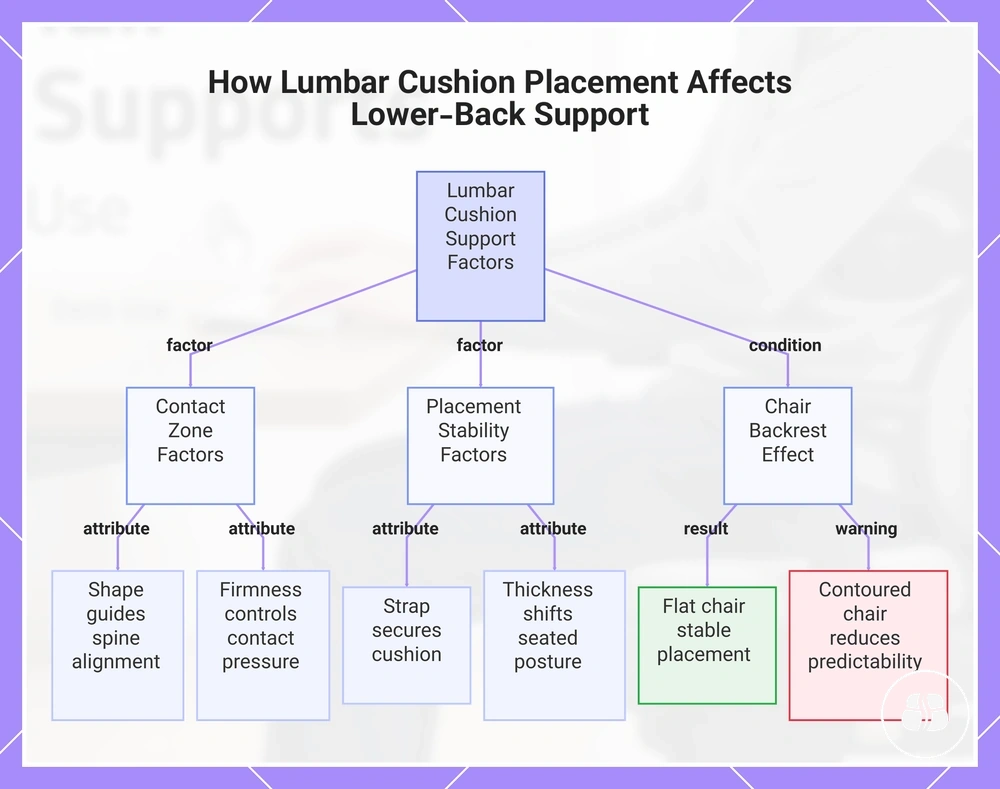
These cushions vary in how they interact with office-chair compatibility, especially through shape, firmness, strap presence, cushion thickness, and backrest matching conditions. Shape influences how closely the cushion follows the spine curve, while firmness changes how much pressure is applied to the lower-back contact zone. Strap security affects whether the cushion stays fixed during movement, and thickness can shift seated posture forward, which may change desk suitability depending on chair depth and seating position.
- Shape: guides how naturally the lumbar cushion aligns with back curvature
- Firmness: affects contact pressure on the lower-back area during sitting
- Strap presence: supports stability across different chair backrests
- Cushion thickness: influences forward seating shift and placement balance
- Backrest compatibility: determines how consistently the cushion stays aligned
In some cases, a lumbar cushion performs more consistently on a flat office chair back because placement remains stable, while heavily contoured chairs can reduce predictable alignment due to built-in shaping. This creates a clear contrast in how placement conditions affect lower-back support behavior across different desk use setups.
This chart shows the key factors that determine lumbar cushion performance and how chair backrest type influences placement stability.
Seat cushions and posture pads for desk sitting
Seat cushions and posture pads for desk sitting change office-chair compatibility by modifying the sitting surface instead of the backrest, which directly affects seating height, tilt, and pressure distribution during desk use. Their impact depends on placement, thickness, and wedge angle, which together define how the seating position shifts and what desk suitability conditions are created.
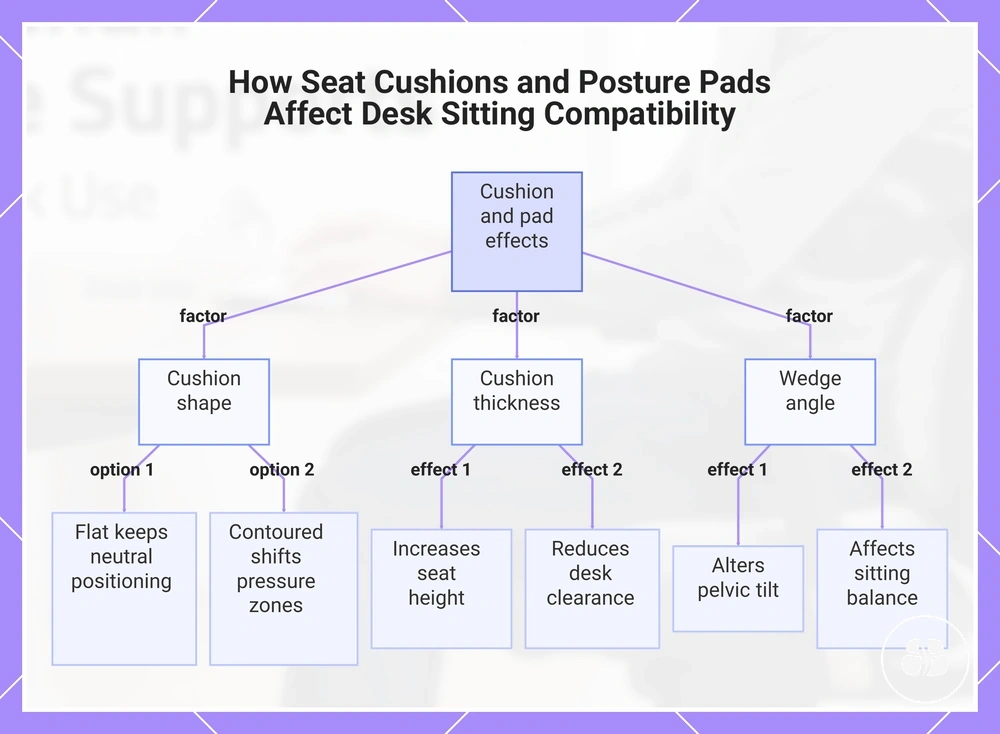
These seat-based supports alter sitting geometry in ways that can improve or disrupt alignment depending on chair setup and user height. A thicker seat cushion increases seat height and may reduce foot contact stability, while a wedge-style posture pad can tilt the pelvis forward or backward depending on orientation. Cushion shape also changes how pressure spreads across the seat, influencing comfort distribution without changing backrest interaction. Because these effects are indirect, they must be evaluated alongside desk height, arm positioning, and foot support conditions.
- Seat pad shape: flat designs keep neutral positioning, contoured shapes shift pressure zones
- Thickness: higher thickness increases seat height and can reduce desk clearance
- Wedge angle: alters pelvic tilt and overall sitting balance
- Chair-height effect: added height can affect foot stability and arm positioning
Extra cushion height can also change arm alignment, monitor level, and foot placement, especially when the chair is already near optimal desk height. This makes seat cushions and posture pads highly dependent on existing workstation setup rather than functioning as isolated adjustments.
This chart shows how cushion shape, thickness, and wedge angle alter seating geometry and desk suitability.
Chair attachments, straps, and wearable posture correctors
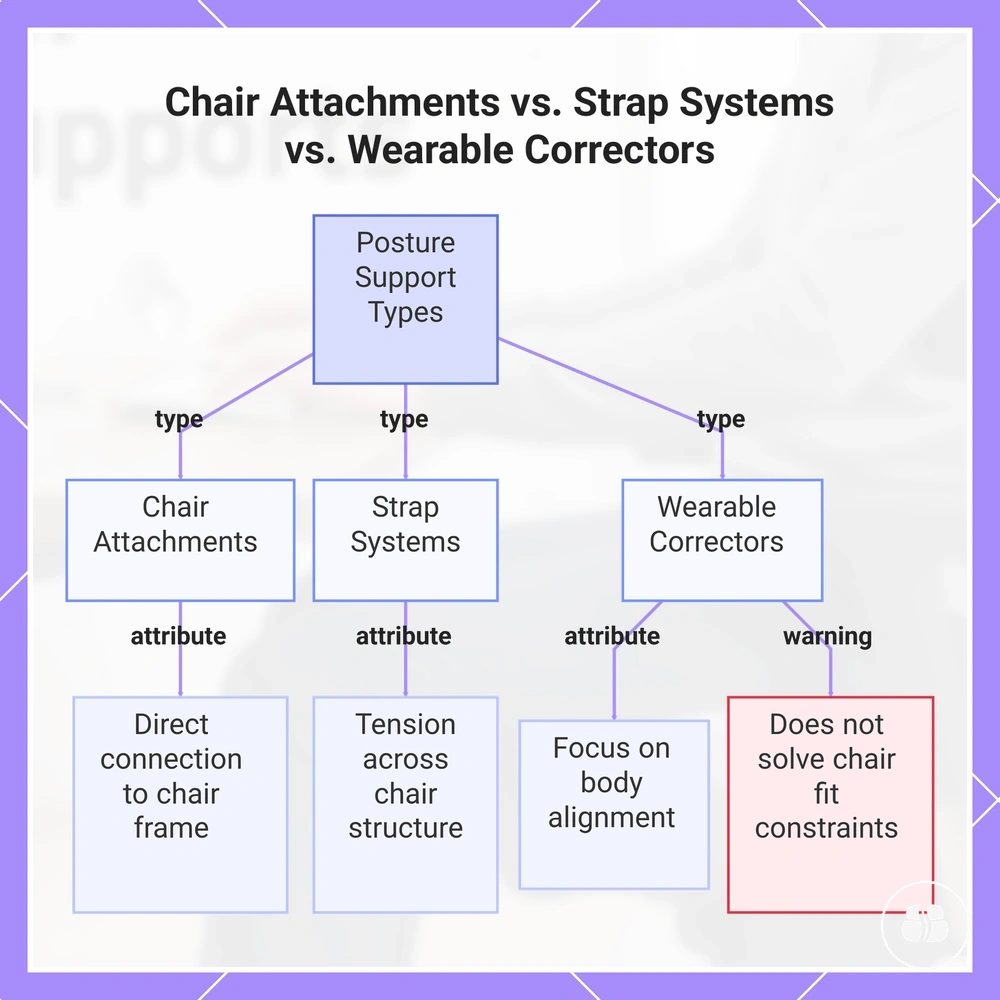
Chair attachments, straps, and wearable posture correctors differ based on whether posture support is fixed to the office chair or worn on the body during desk use. Chair attachment systems rely on direct connection to the chair frame or backrest, while strap-based supports depend on tension across the chair structure to maintain placement. A wearable posture corrector shifts support away from the chair entirely and focuses on body alignment, which changes how desk suitability is evaluated in seated conditions.
These formats are mainly distinguished by attachment point, strap stability, shoulder involvement, movement restriction, and desk-task comfort. Chair attachments and strap systems interact directly with the chair structure and may work alongside a lumbar cushion or seat cushion depending on placement conditions. Wearable posture correctors, however, do not depend on chair geometry but can still influence posture awareness during sitting. This creates a clear boundary where chair-mounted supports address structural compatibility, while wearable systems operate independently and may not resolve chair-fit limitations caused by seat or backrest design.
Boundary note: wearable posture correctors may support posture awareness during desk sitting, but they do not directly solve chair attachment or seat geometry constraints that affect desk suitability.
This chart compares the three main types of posture support for desk use based on their attachment method and relationship to the chair.
Desk-use conditions that change the right support choice
Desk work support needs shift depending on sitting duration and workspace setup. A lumbar cushion, seat cushion, chair attachment, strap system, or wearable posture corrector can behave differently depending on how long desk work continues and how frequently movement breaks occur. This creates a decision frame based on real desk-use conditions rather than a fixed accessory choice.
Support choice is also influenced by keyboard reach, monitor height, chair height, and task intensity during desk work. Longer sitting duration often increases the need for more stable placement, while frequent movement breaks can reduce reliance on fixed positioning. Monitor height and chair height affect upper-body alignment, and keyboard reach influences forward lean and arm positioning. These combined conditions shape how a chair attachment, strap, or wearable posture corrector may perform in real use, depending on placement and desk suitability.
For example, desk work with extended sitting duration and limited movement breaks may favor more stable chair attachment setups, while desk work with frequent movement breaks and changing task intensity may suit more flexible placement-based support. This shows how the same accessory can change performance depending on the conditions it is used in.
| Factor | Condition | Fit effect | Decision cue |
|---|---|---|---|
| Sitting duration | Short or extended desk work periods | Changes need for stability | Long duration may require steadier support |
| Movement breaks | Frequent or limited breaks | Affects reliance on fixed positioning | More breaks reduce rigidity need |
| Monitor height | High or low screen position | Influences upper-body alignment | Align support with screen level |
| Chair height | Adjusted seating position | Changes posture balance | Match support to seating setup |
| Keyboard reach | Close or extended reach | Affects forward lean and arm load | Reduce strain via positioning |
Sitting duration, movement breaks, and posture reminders
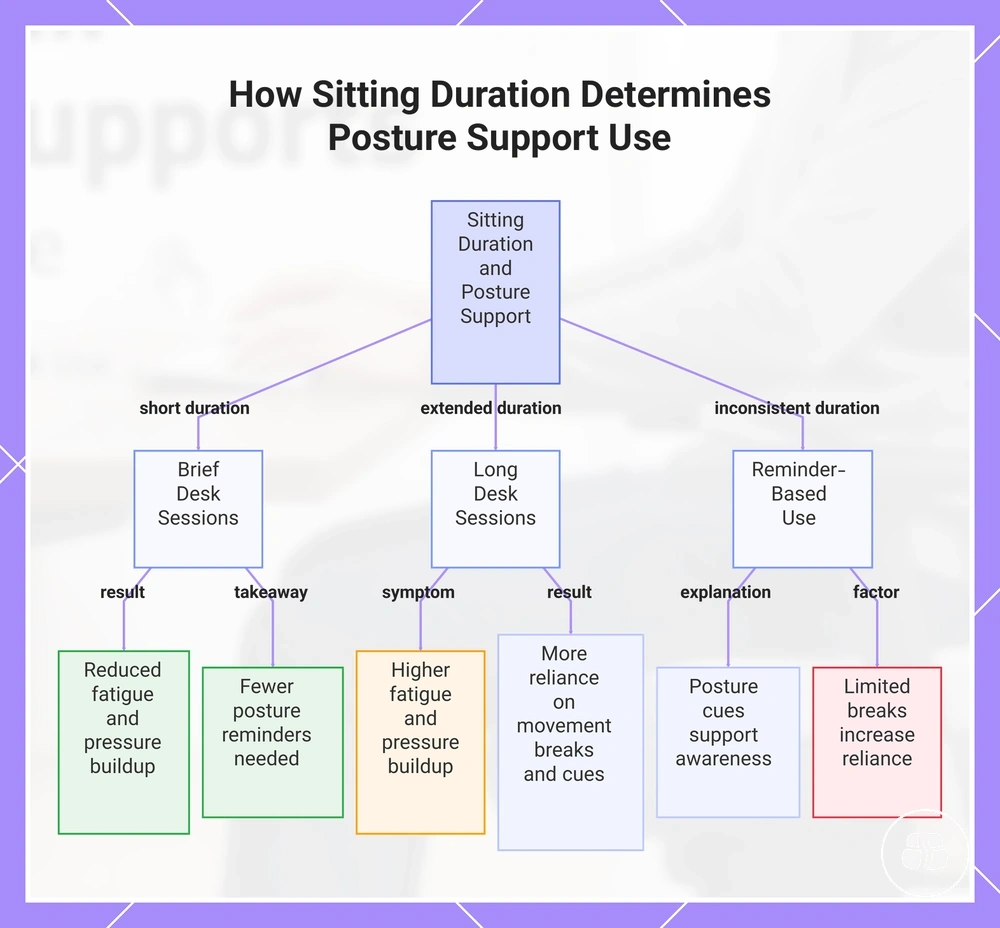
Sitting duration, movement breaks, and posture reminders affect how office-chair posture support is used during desk work because time spent seated changes comfort buildup and attention to posture. Short sitting duration usually reduces the need for reminders, while longer desk work periods can increase fatigue and pressure buildup, making posture cues more relevant. This creates a time-based condition for how support and reminders are used together.
These factors interact with monitor height, chair height, and keyboard reach, which influence how the body stays aligned during desk work. Limited movement breaks may increase reliance on posture reminders, while frequent breaks can reduce that dependency. However, longer sitting duration usually benefits from combining movement planning with accessory fit rather than relying only on a posture aid. The practical implication is that time spent sitting shapes whether support use stays passive or becomes reminder-driven.
- Brief desk sessions: Lower fatigue and minimal pressure buildup, fewer posture reminders needed
- Long desk sessions: Higher fatigue risk and increased pressure buildup, more reliance on movement breaks and cues
- Reminder-based use: Posture cues support awareness when sitting duration is inconsistent or extended
This chart shows how brief and long desk sessions, along with inconsistent duration, affect the need for posture reminders and movement breaks.
Monitor height, chair height, and 90-90-90 sitting alignment
Monitor height, chair height, and 90-90-90 sitting alignment affect how desk work posture support performs because alignment between screen position and seating setup can support or undermine accessory usefulness. When sitting duration increases, small mismatches in monitor height or chair height may change comfort and consistency. Movement breaks can reduce accumulated strain, but overall alignment still shapes how the posture aid interacts with the body during desk work. This creates a condition frame focused on alignment rather than fixed ergonomic outcomes.
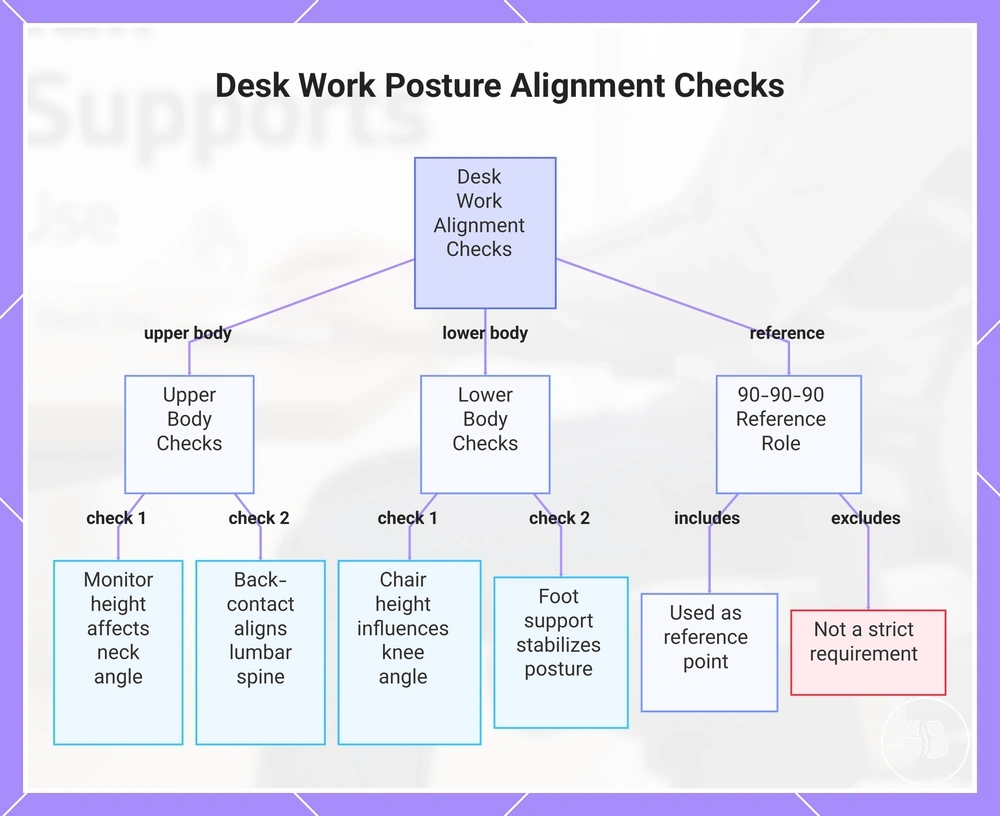
These conditions interact with keyboard reach, elbow position, and back-contact support during desk work, where the 90-90-90 sitting alignment is used as a reference point rather than a strict requirement. Chair height may influence knee angle, while monitor height affects neck orientation, and keyboard reach changes arm extension patterns. Back-contact position determines how lumbar support or chair support attachment engages with the spine during sitting duration. The practical implication is that accessory benefit depends on how these elements align together rather than individually.
This checklist organizes alignment checks that influence office-chair compatibility and posture support effectiveness during desk work.
- Monitor height: influences visual line and upper-body orientation during sitting duration
- Chair height: affects knee angle and lower-body positioning relative to desk setup
- Elbow angle: changes how keyboard reach affects arm load and posture balance
- Knee angle: reflects interaction between chair height and sitting duration comfort
- Foot support: stabilizes posture and reduces uneven pressure buildup during desk work
- Back-contact position: determines lumbar alignment with office chair back support
This chart organizes the key alignment checks for desk work posture, covering upper body, lower body, and the role of the 90-90-90 reference alignment.
Compatibility checks before choosing office chair back support
Compatibility checks before choosing office chair back support depend on how chair part conditions interact with body contact and attachment security during desk work. When sitting duration increases, small mismatches between support position and chair structure can influence stability and comfort. Movement breaks may reduce pressure buildup, but the main decision signal comes from whether the support position aligns correctly with the chair setup and use condition.
These checks focus on compatibility check logic across chair part, body contact, attachment security, and support position, where each factor produces a decision signal based on condition. A stable setup depends on whether the chair part allows secure attachment and whether body contact aligns with lumbar support position during desk work. When any of these conditions show mismatch, the outcome often shifts from shortlist suitability to reconsideration of the accessory format or setup.
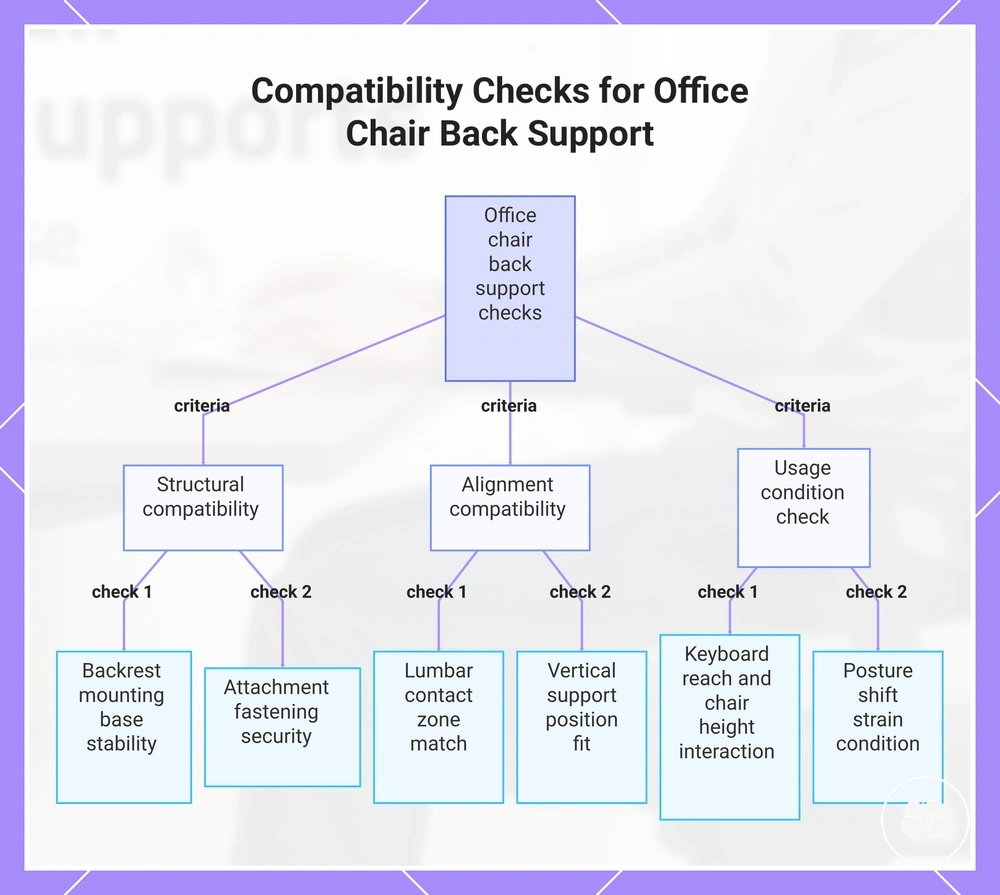
Before selecting office chair back support, the following compatibility check organizes key verification points that help separate suitable setups from risky or unstable ones.
Compatibility check overview: This checklist organizes chair part condition, body contact alignment, attachment security, and support position into clear decision signals for pre-selection evaluation.
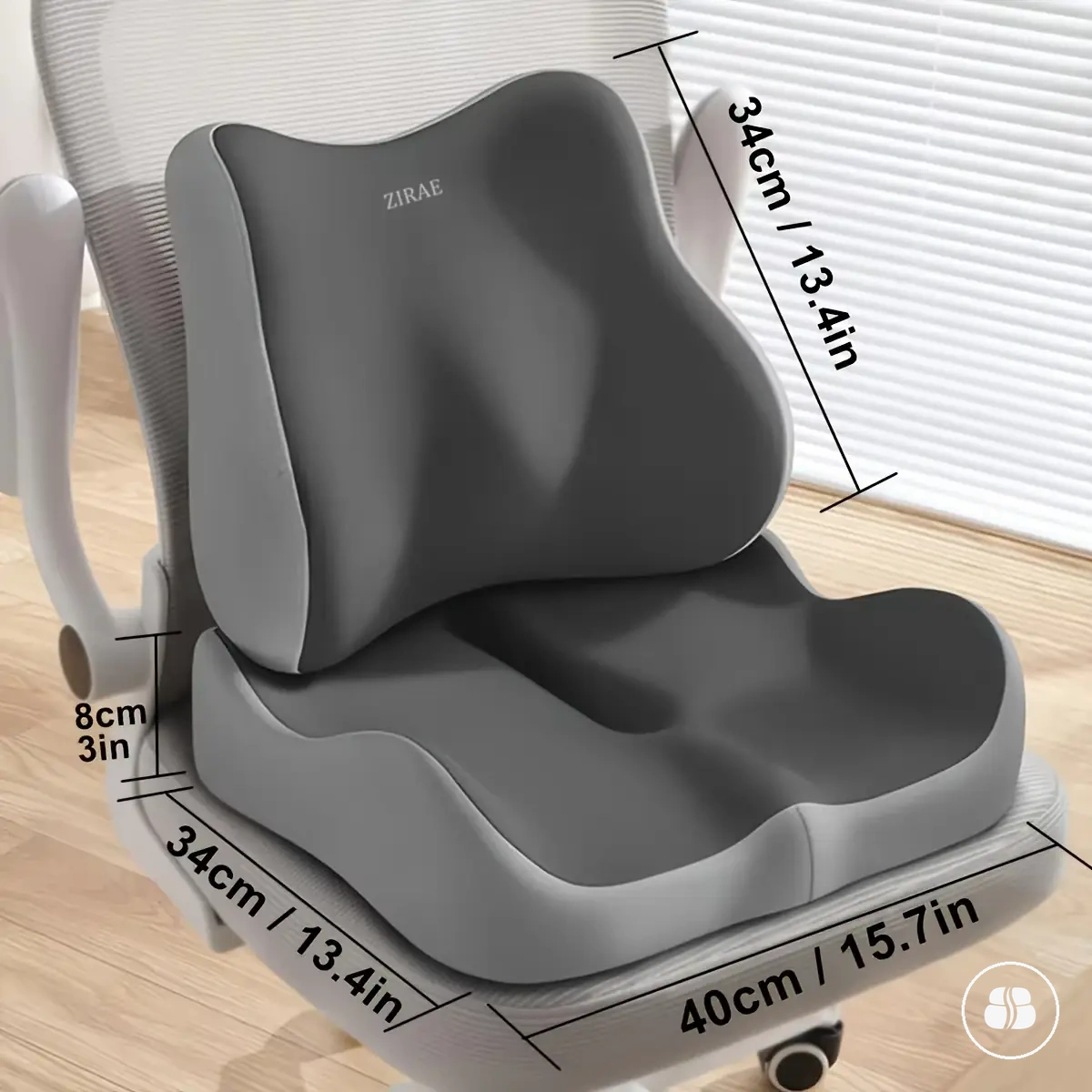
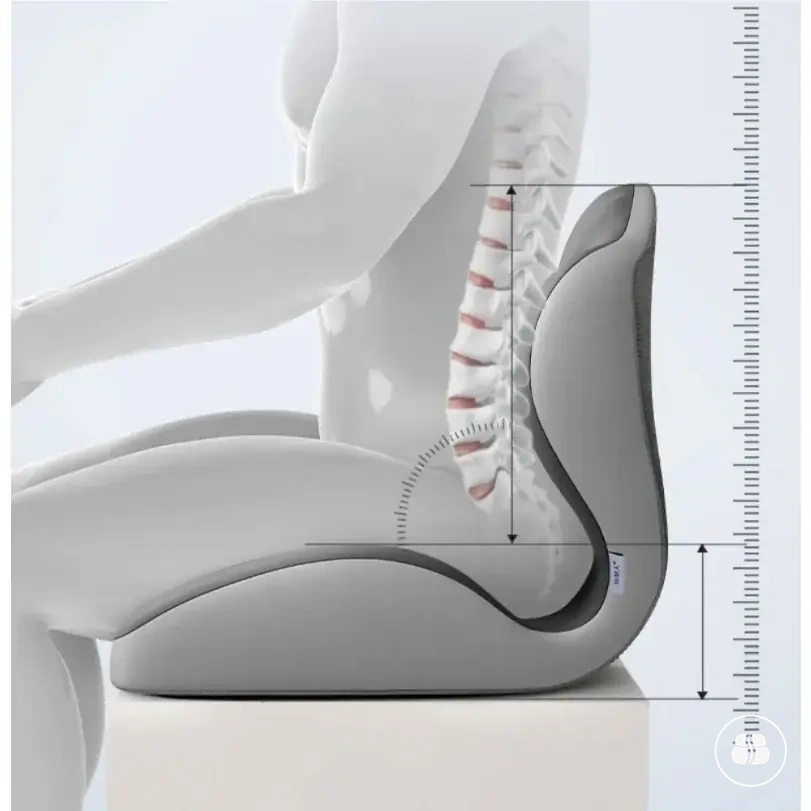
The products below are useful examples for comparing available options. Before buying, check that the compatibility criteria, key features, and product details match your needs.
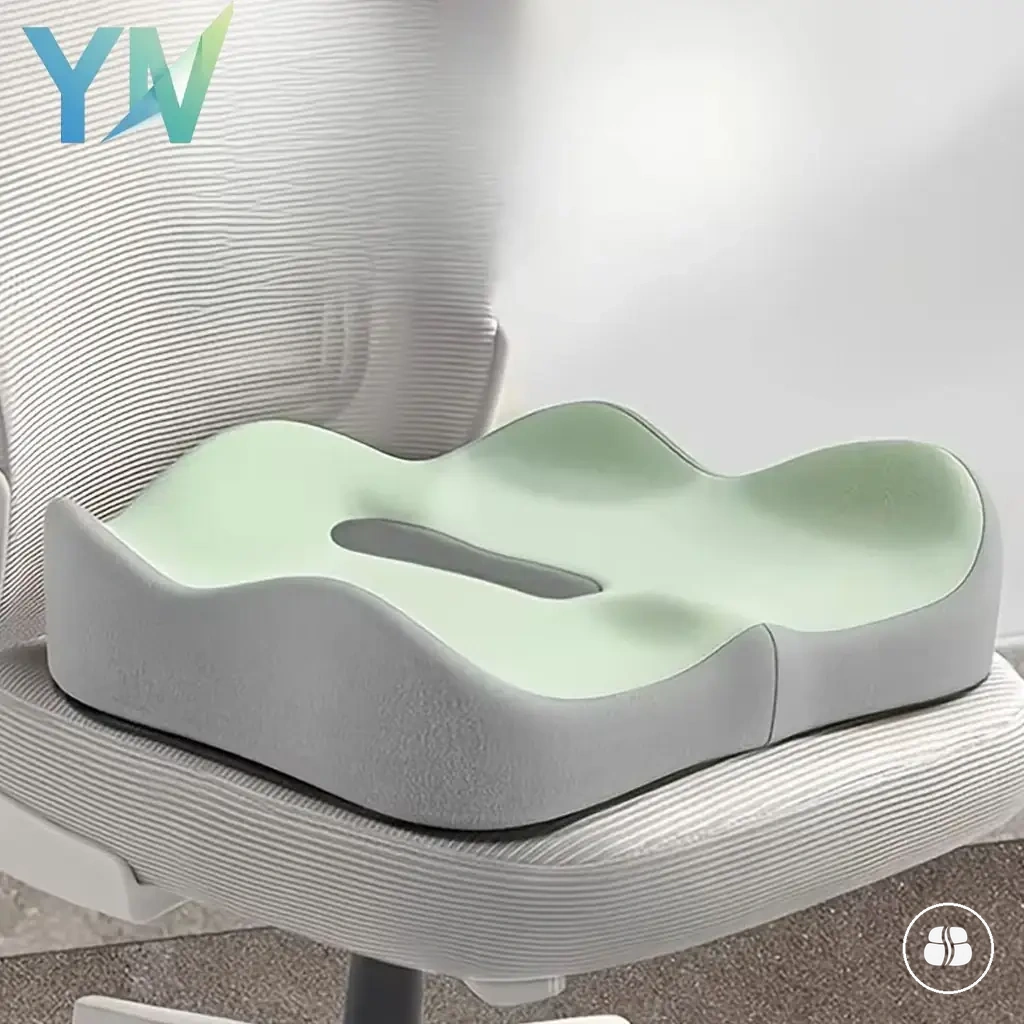
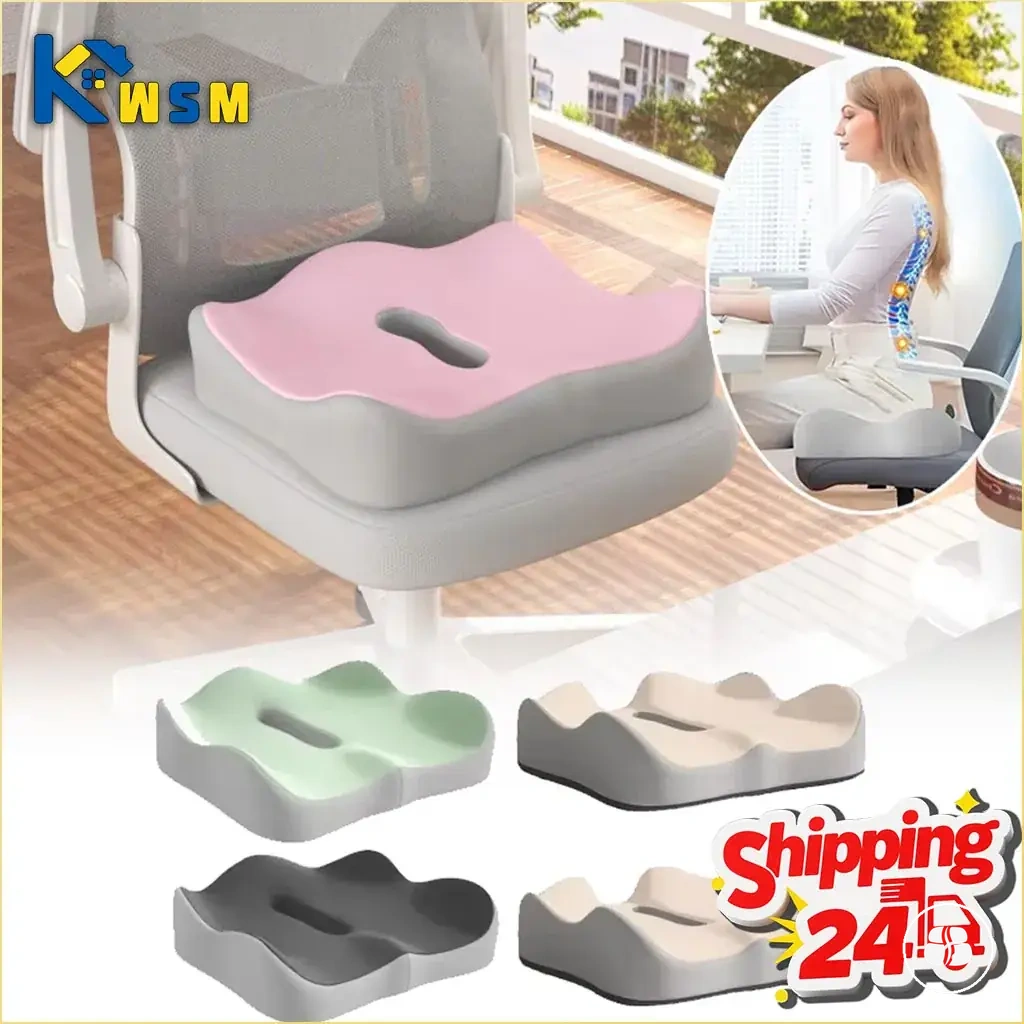
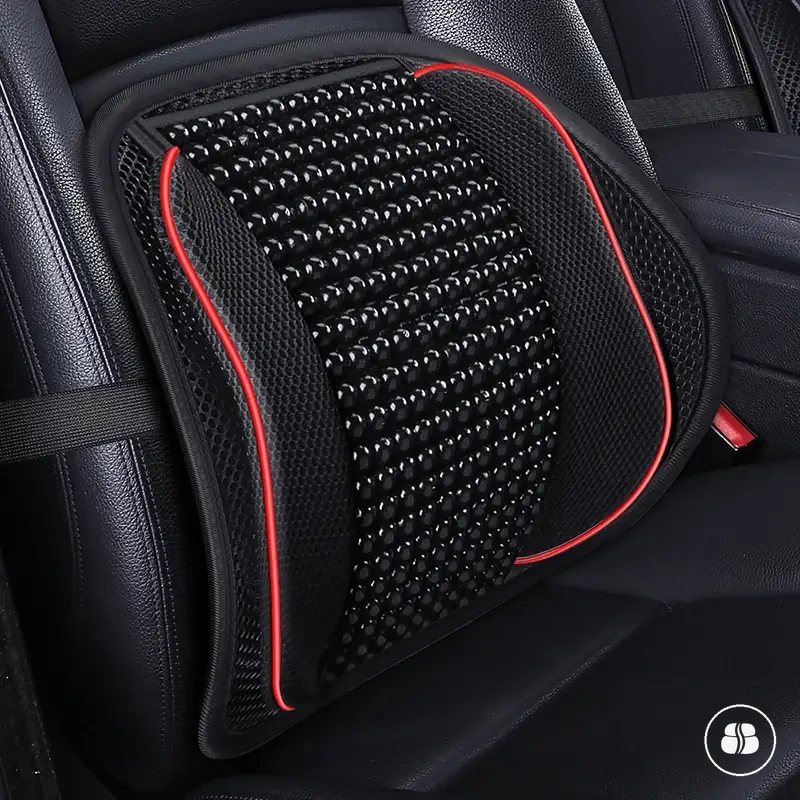
- Chair part condition: backrest structure → surface compatibility → stable or unstable mounting base → determines whether attachment security can hold during desk work
- Body contact alignment: lumbar contact zone → match with support shape → aligned or misaligned pressure distribution → affects comfort consistency during sitting duration
- Attachment security: fastening stability → grip on chair part → secure or shifting attachment → signals whether repositioning risk is acceptable
- Support position fit: vertical lumbar placement → spine alignment range → correct or offset support position → impacts ergonomic usefulness during desk work
- Desk-use effect: keyboard reach and chair height interaction → posture shift impact → balanced or forward strain condition → informs final decision signal
This chart organizes the key verification points for evaluating office chair back support compatibility based on structural, alignment, and usage checks.
Chair stability, attachment security, and non-slip support
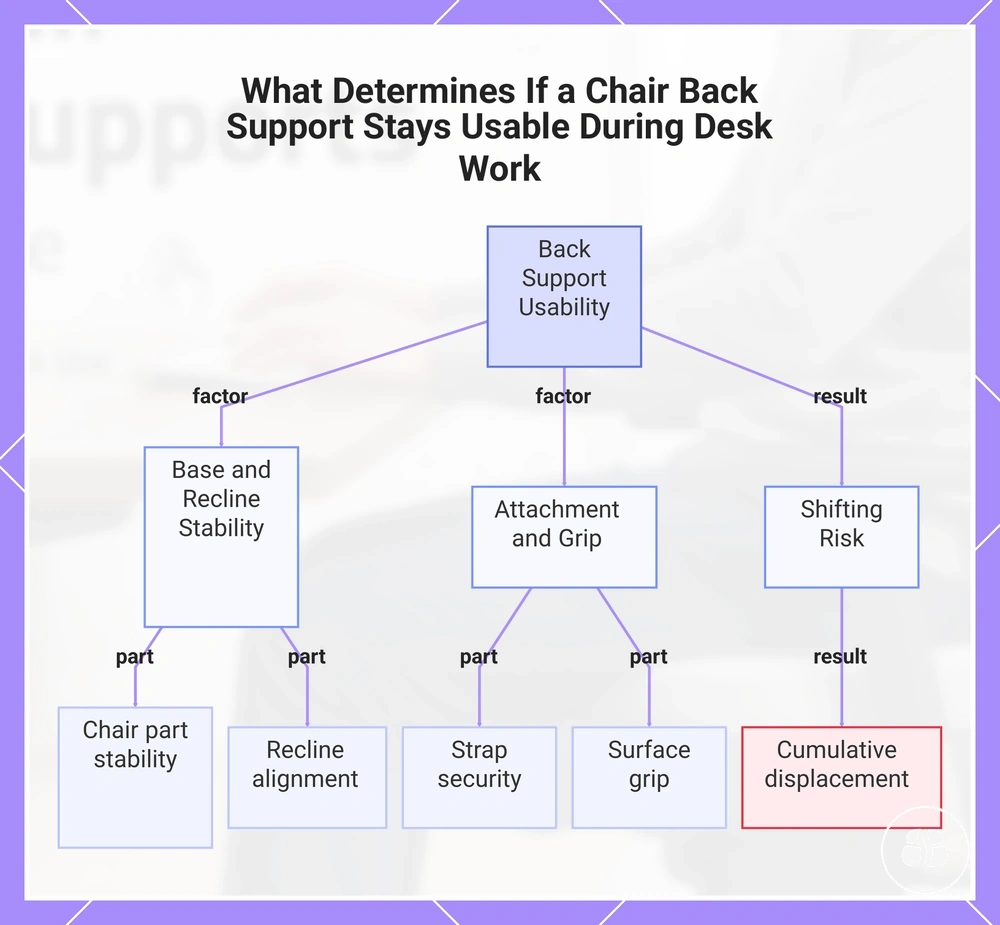
Chair stability, attachment security, and non-slip support determine whether an office chair back support remains usable during desk work because even well-shaped support can fail if it shifts under movement. When sitting duration increases, small instability in the chair part or weak attachment security can reduce consistent body contact. Movement breaks may reposition the user, but the main decision signal comes from whether the support position stays stable during normal use conditions, forming the core fit condition.
These factors define how chair stability interacts with attachment security and non-slip support to maintain fit condition across different chair movements. A stable chair part allows better grip, while weak friction surfaces or loose strap security can create gradual shifting of support height and body-contact position. Support height and firmness also influence overall fit condition by changing how pressure is distributed across the backrest, while strap security and non-slip support determine whether the setup holds during movement. Recline behavior also affects whether the support remains aligned or drifts away from the intended lumbar zone during desk work, impacting usability.
Example condition: A lumbar support may match the chair shape correctly, but if the surface grip is low or strap security is weak, it can slide downward during normal sitting, reducing usable support position even though initial fit seems correct.
- Chair movement: chair part stability → movement resistance → stable or shifting base → affects overall support consistency
- Strap tension: attachment security → strap security level on chair frame → secure or loose hold → determines risk of displacement during sitting duration
- Surface grip: non-slip support → friction level between chair and support → firm or sliding contact → impacts body-contact position stability
- Recline behavior: chair angle change → support alignment shift → stable or drifting support position → influences lumbar consistency
- Shifting risk: combined stability factors → cumulative movement effect → low or high displacement risk → defines usability over extended desk work
This chart shows the main factors that determine whether an office chair back support remains stable and effective over time, including base stability, attachment security, and the resulting shifting risk.
Support height, firmness, and body-contact position
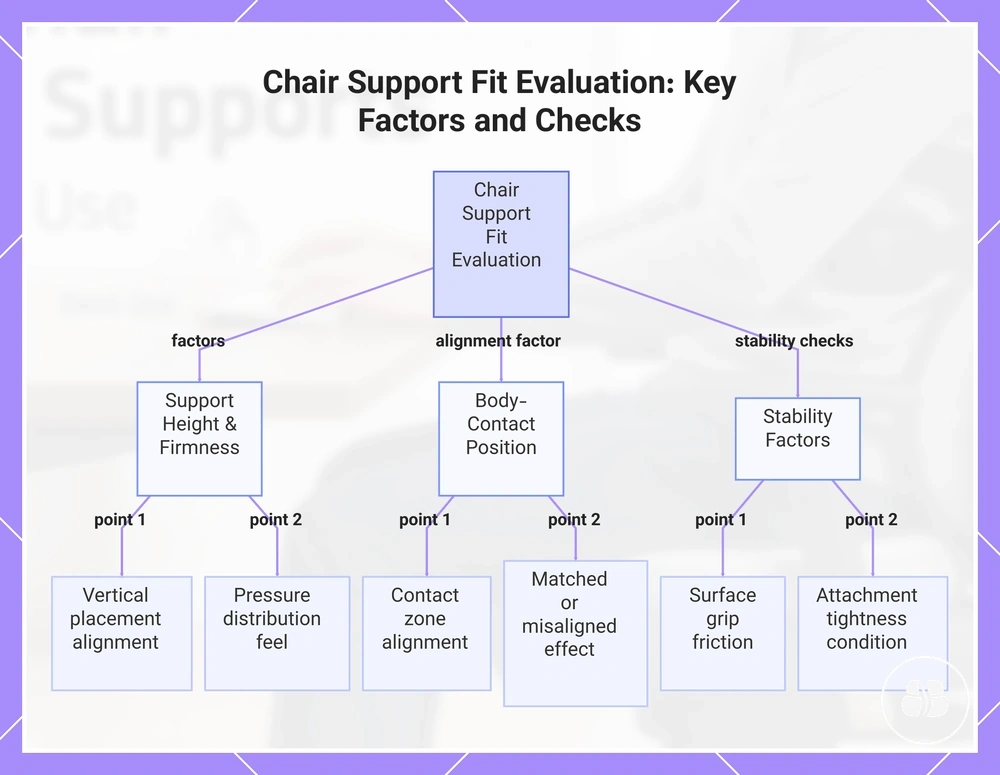
Support height, firmness, and body-contact position depend on how the chair setup aligns with the intended contact zone during desk use. When these variables are mismatched, the office chair back support may shift away from the correct lumbar or seat area, changing the overall fit condition. This creates a decision frame based on whether support height and firmness align with stable body-contact position under real sitting conditions.
These factors work together to determine whether a desk posture support maintains consistent contact or shifts during use. Support height defines where the accessory sits on the chair, firmness influences how pressure is distributed, and body-contact position determines whether the user’s back or seat area is correctly engaged. Strap security and non-slip support affect whether this alignment remains stable over time, especially during movement breaks or recline changes.
Before selecting a setup, the following checklist organizes key compatibility check points for support height, firmness, and body-contact position to evaluate fit condition during desk work.
Compatibility checklist: This section organizes support height, firmness, body-contact position, non-slip support, and strap security as decision signals for fit evaluation.
- Support height: chair part → vertical placement → correct or offset alignment → determines whether lumbar or seat contact is reached properly
- Firmness: material response → pressure distribution → stable or uneven support feel → affects consistency of contact during sitting duration
- Body-contact position: contact zone → alignment with spine or seat area → matched or misaligned effect → influences usability of support during desk work
- Non-slip support: surface grip → friction level with chair → stable or shifting base → impacts long-term position stability
- Strap security: fastening condition → attachment tightness → secure or loose fit condition → affects movement resistance
For sizing alignment, Posture support accessories fit and sizing may help compare how support height and firmness interact with body-contact position across different chair setups. Fit confidence depends on physical contact behavior and real seating conditions rather than guaranteed posture correction outcomes.
This chart organizes the main compatibility check points for support height, firmness, body-contact position, and stability factors to evaluate fit condition during desk work.
When posture support accessories are not enough for office-chair problems
Posture support accessories are not enough for office-chair problems when sliding support, persistent pressure, or instability continues due to chair limitation or accessory mismatch. In these cases, the issue is not only placement but a deeper fit condition between the chair structure and the accessory, which requires separating accessory mismatch from chair limitation as the main decision frame.
In many setups, adjusting a desk posture support, lumbar support, or seat accessory may reduce minor discomfort, but it cannot resolve underlying structural problems in the chair. When body-contact position remains unstable or persistent pressure continues even after adjustment, the issue often indicates chair limitation rather than accessory performance. At this stage, continued use should be evaluated carefully, and if discomfort increases, stop use becomes a relevant signal alongside reassessing fit condition.
The following diagnostic signals help separate accessory mismatch from chair limitation during desk use.
- Sliding support: accessory shifts during sitting, often linked to weak non-slip support or incompatible chair surface
- Persistent pressure: uneven load remains after adjustment, indicating deeper seat or backrest limitation
- Poor foot contact: unstable grounding caused by chair height or seat depth mismatch
- Armrest conflict: arm positioning interferes with posture alignment due to fixed or poorly adjusted armrests
- Unstable recline: backrest movement changes body-contact position unpredictably during use
For example, a lumbar support may appear correctly placed, but if the chair reclines unevenly or foot contact remains unstable, discomfort can persist. In such cases, adjusting only the accessory is often less effective than addressing chair limitation or reconsidering use when fit condition continues to degrade.
This chart shows the diagnostic signals that indicate when posture support accessories are insufficient due to accessory mismatch or chair limitation, and the recommended corrective actions.
Office chair accessories versus replacing the chair
Office chair accessories versus replacing the chair depends on the problem source and whether the issue comes from surface-level adjustment or deeper structural fit. Accessory adjustment can handle limited support gaps, while chair replacement becomes relevant when the chair itself creates persistent alignment issues. This decision frame separates temporary support from structural fit as the main condition for evaluation.
In many desk setups, accessory adjustment such as lumbar support or seat posture aid works as temporary support when the chair structure is generally usable. However, when sliding support, persistent pressure, or unstable positioning continues, the issue may point to chair limitation instead of accessory mismatch. At this point, the decision signal depends on whether accessory changes still improve body-contact position or whether structural fit prevents stable alignment even after adjustments.
The comparison below organizes how accessory adjustment and chair replacement differ based on problem source, condition, and likely outcome. It helps distinguish temporary support cases from situations where structural fit becomes the limiting factor.
| Factor | Condition | Fit effect | Decision cue |
|---|---|---|---|
| Problem source | Surface discomfort vs structural chair limitation | Accessory adjustment may partially improve support | Identify accessory mismatch or chair replacement need |
| Accessory adjustment | Minor alignment or comfort gaps | Can improve temporary support and posture alignment | Suitable when chair structure remains stable |
| Chair replacement | Persistent structural fit issues | Restores baseline alignment potential | Relevant when instability or pressure persists |
| Structural fit | Backrest, seat depth, recline mismatch | Limits effectiveness of accessories | Indicates deeper chair-level constraint |
For example, a chair with stable structure but mild discomfort may respond well to accessory adjustment as temporary support, while a chair with ongoing instability or persistent pressure despite changes may indicate a structural fit problem. In such cases, the decision signal shifts from accessory tuning toward evaluating chair replacement as a more relevant option.
The products below are useful examples for comparing available options. Before buying, check that the compatibility criteria, key features, and product details match your needs.