
Using Car Organizers Effectively
Car organizers are in-vehicle storage systems that structure stored items across compartments to reduce clutter and improve accessibility. Effective use means placing items based on access frequency and maintaining separation between categories of items. In practice, effective car organizer use is defined by access, separation, stability, and reset discipline.
The main usage logic depends on matching stored items with the correct vehicle area such as trunk, backseat, or console and aligning them with access frequency during driving context. Frequently used items should remain in reachable compartments while low-frequency items can be stored deeper. This connection between vehicle area and access frequency shapes how compartments are distributed.
Stability of a car organizer depends on item weight, compartment structure, surface contact, and driving context. Different layouts and organizer designs may shift how secure stored items remain during movement. Heavy items may require lower placement while lighter items can remain in flexible compartments.
A consistent reset routine helps maintain order by periodically returning stored items to their intended compartments after changes in use. This supports long-term control over clutter without relying on permanent fixed arrangements.
What Effective Car Organizer Use Means
Effective car organizer use means matching stored items, compartments, and vehicle placement to real access needs rather than simply filling available storage space. It defines how a car organizer is used to align item location with usability inside the vehicle, where placement determines how easily items can be reached and managed.
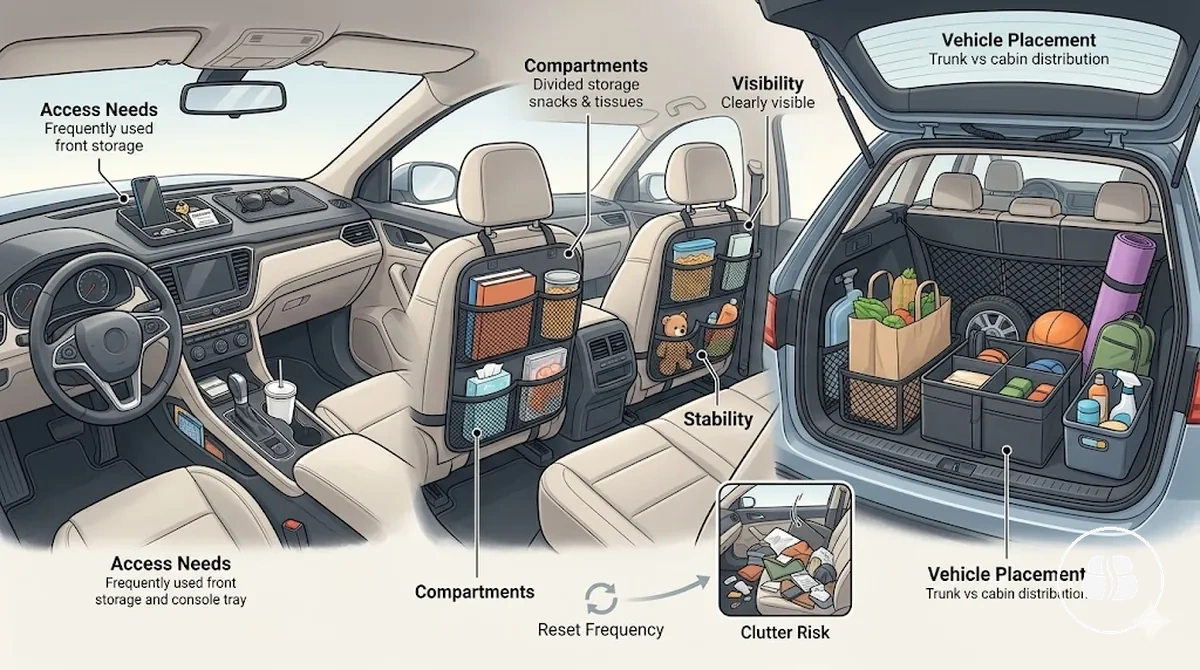
Effective car organizer use depends on how access needs, visibility, and stability are balanced across compartments and vehicle placement. Items placed without considering reach or compartment logic can reduce usability and increase clutter over time.
- Access needs: Items placed based on how often they are needed during driving
- Visibility: Stored items arranged so they remain easy to identify and reach
- Stability: Compartment support that helps reduce shifting during driving
- Reset frequency: How often items are returned to intended compartments after use
Reset frequency shapes how consistently organization is maintained because stored items can shift with repeated trips and changing usage patterns. Effective car organizer use also involves distinguishing between structured placement and temporary storage habits that develop during daily driving. In contrast to simply filling pockets, buying more organizers, or storing every loose item without logic, effective use focuses on controlled placement and item condition awareness to reduce unnecessary clutter over time.
Type, fit, and material can influence how effective car organizer use performs in different vehicle setups, but these factors are handled in more detailed sections focused on selection and structure. Back to hub overview
Sort Car Items Before Assigning Organizer Space
Unsorted items often turn a car organizer into a clutter container where storage space loses its structure and usefulness. The process of sort car items is a control step that defines how organizer space will be used inside the vehicle. It organizes items based on item category, access frequency, size, weight, cleanliness, emergency value, and removal priority, and sorting controls organizer space.
Before assigning anything to compartments, items should be evaluated through a structured sorting logic that links storage decisions to real access needs and vehicle placement behavior. This prevents random filling and keeps visibility, stability, and item condition aligned with use patterns. Each item should be judged before placement.
- Item category: Group items such as daily essentials, receipts, bottles, tools, kids items, and emergency supplies to define organizer space zones
- Access frequency: Separate frequently used items from rarely used items to decide reachable storage versus trunk storage placement
- Size: Match item dimensions to compartments to prevent wasted organizer space and unstable placement
- Weight: Assign heavier items to stable compartments to reduce shifting during driving context
- Cleanliness: Separate clean items from dirty or loose items to reduce clutter risk inside storage areas
- Emergency value: Prioritize fast-access placement for items that may be needed in urgent situations
- Removal priority: Identify items that should be removed or relocated to avoid long-term clutter buildup
After sorting, organizer space becomes structured around real usage patterns instead of random storage decisions. This improves clarity in compartments, supports stability during driving, and reduces clutter risk over repeated trips. Only items that match access needs and item condition should remain in reachable storage, while less useful items can stay in secondary or trunk areas.
Keep, Remove, Relocate, and Dispose Items
Item handling in a car organizer depends on current relevance and how each object affects available organizer space inside the vehicle. Each item is evaluated based on its use value and placement need, which leads to a clear action decision across four categories: keep, remove, relocate, and dispose.
This action logic prevents low-value or unused items from occupying limited organizer space and helps maintain structured storage behavior. When items are continuously reviewed, available organizer space stays aligned with real driving needs and reduces long-term clutter buildup such as outdated receipts and loose packaging.
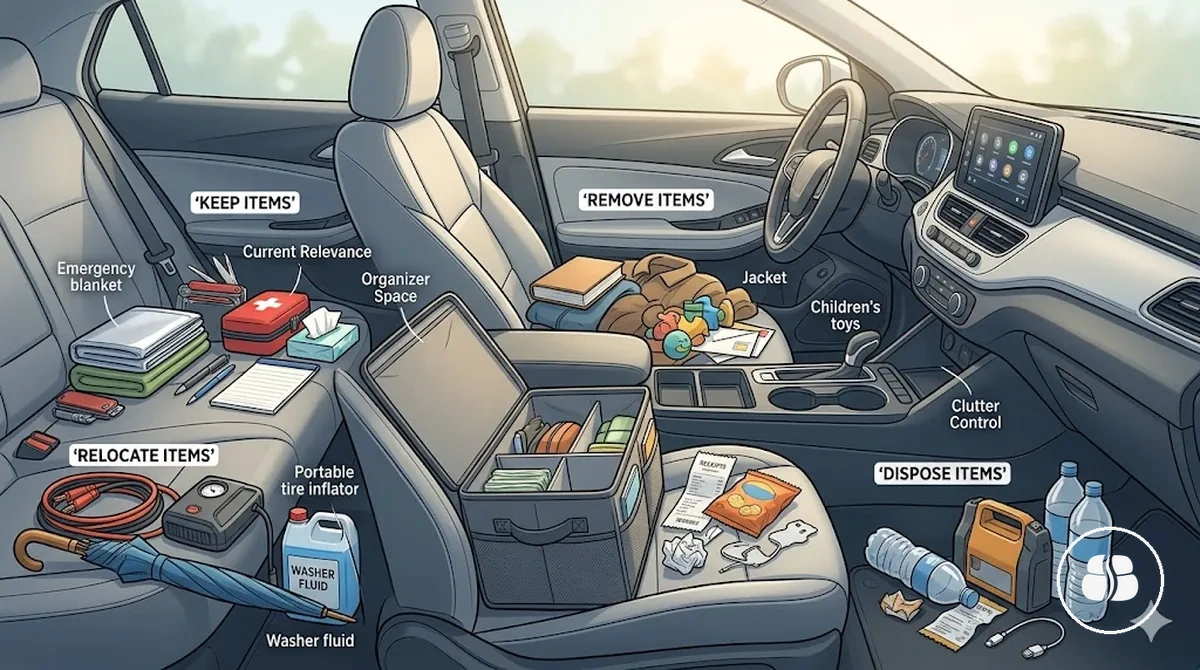
- Keep: Items with current relevance and frequent access needs remain in reachable compartments, preserving efficient organizer space
- Remove: Outdated receipts or loose packaging are taken out to free up organizer space and reduce clutter
- Relocate: Duplicate accessories or items better suited for home storage or trunk storage are moved away from primary compartments
- Dispose: Broken or unusable items are discarded completely, increasing available organizer space and improving storage clarity
Group Items by Access Frequency and Use Case
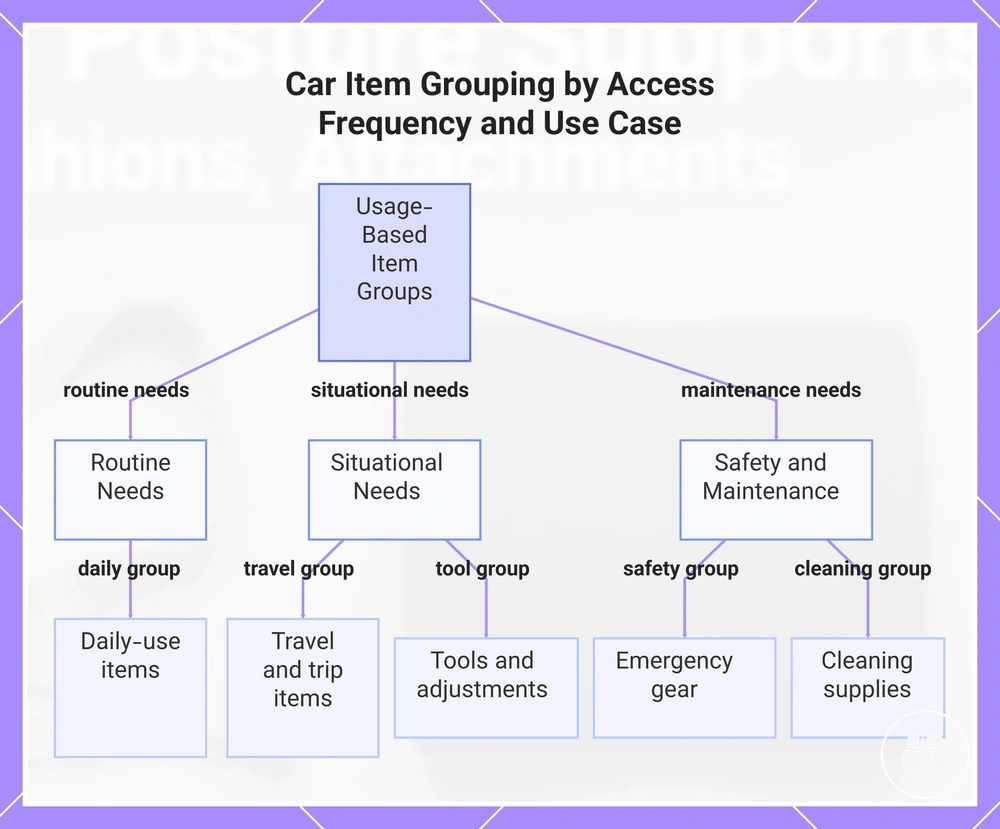
Grouping items by access frequency and use case means organizing car contents according to how often and why they are needed during driving situations. This ensures that access frequency directly shapes how each item group is formed inside the vehicle. It keeps storage decisions aligned with real driving behavior rather than random placement.
These usage groups help separate routine needs from situational needs and reduce overlap between different item types during use.
- Daily-use items: High access frequency items used in routine driving, typically kept in reachable storage for quick access during trips
- Travel items: Occasional use items needed during longer trips, usually stored in trunk areas due to lower access frequency
- Grocery-related items: Trip-specific items grouped based on shopping purpose and handled as temporary storage loads
- Kids items: Passenger-focused items grouped for supervision and containment needs during travel situations
- Tools: Functional items used for repairs or adjustments, grouped separately due to situational access requirements
- Emergency gear: Safety-oriented items stored for rare but important use cases, often positioned for predictable reach
- Cleaning supplies: Maintenance items used intermittently to manage vehicle cleanliness and kept separate from daily-use items
When items are grouped this way, both access frequency and use case remain consistent drivers of organization. This reduces confusion between categories and supports clearer storage behavior during different driving situations. An item such as a tool may shift between travel items and emergency gear depending on the driving situation and need context.
This chart shows the main usage-based categories for organizing car items according to access frequency and use case, along with example item groups.
Place Car Organizers Where Items Are Actually Used
Car organizer placement refers to selecting a vehicle area based on where items are actually used during travel. It depends on access need, driver reach, passenger comfort, and visibility inside the vehicle. Front seat, console, backseat, trunk, and cargo area each support different usage behavior, so placement follows actual item use rather than fixed position rules. This placement follows actual item use.
Placement logic can be mapped by comparing vehicle area with how items are accessed and managed during trips. The rows below show how access need and passenger context organize typical organizer location decisions, and access need and passenger context organize the rows.
| Vehicle area | Items usually used there | Access reason | Placement caution |
|---|---|---|---|
| Front seat / Console | Phones, small essentials, documents | Driver reach and quick visibility | Avoid blocking controls or reducing visibility |
| Backseat | Kids items, bags, passenger supplies | Passenger comfort and supervision | Keep items secured during movement |
| Trunk | Travel items, groceries, larger bags | Lower access frequency and storage volume | Organize by loading pattern to prevent shifting |
| Cargo area | Bulky tools, emergency gear | Extended storage and infrequent access | Maintain stability during transport |
Different driving situations can shift the same item between vehicle areas. Wipes, bottles, or bags may move from the console to the backseat or trunk depending on passengers or trip purpose. When usage context changes, car organizer placement should adjust to maintain appropriate driver reach, passenger comfort, and visibility depending on driver reach or passenger comfort.
Front Seat and Console Access
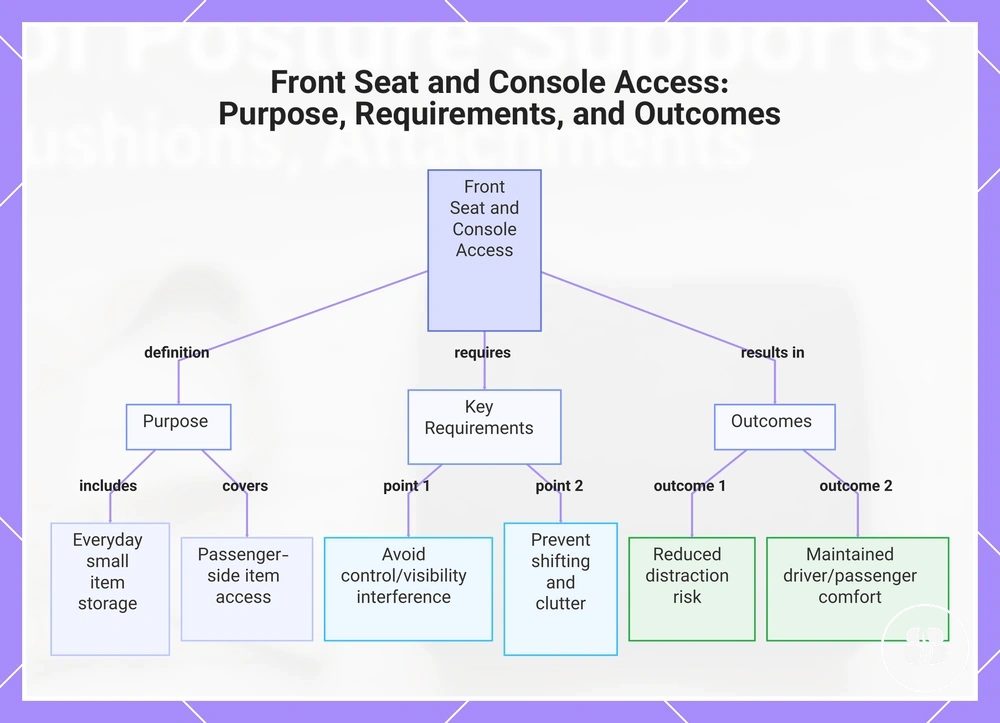
Front seat and console access is used in everyday driving when small items need to stay within immediate reach. This setup relies on front seat, console access, and reachable storage areas close to the driver. It typically includes documents, charging cables, tissues, sanitizer, small accessories, and passenger-side items that must remain easy to reach during short stops or quick use.
Effective use of front seat and console storage depends on reach, obstruction risk, and passenger comfort. Items should remain positioned where they do not interfere with controls or reduce visibility inside the vehicle. Poor placement can increase obstruction risk and affect comfort for both driver and passenger. Console storage should stay controlled to prevent shifting during movement, and maintaining clear reach without clutter reduces distraction risk and helps avoid handling loose items during driving.
This chart explains the definition of front seat and console access, the key requirements for effective use, and the positive outcomes of proper storage.
Backseat and Passenger Storage
Backseat storage refers to passenger-focused organization in the rear vehicle area where items are accessed during shared travel. It depends on family access patterns and how passengers reach and use items during the trip. This space typically includes toys, snacks, wipes, books, bottles, and travel accessories, shaping backseat storage around passenger access and containment need.
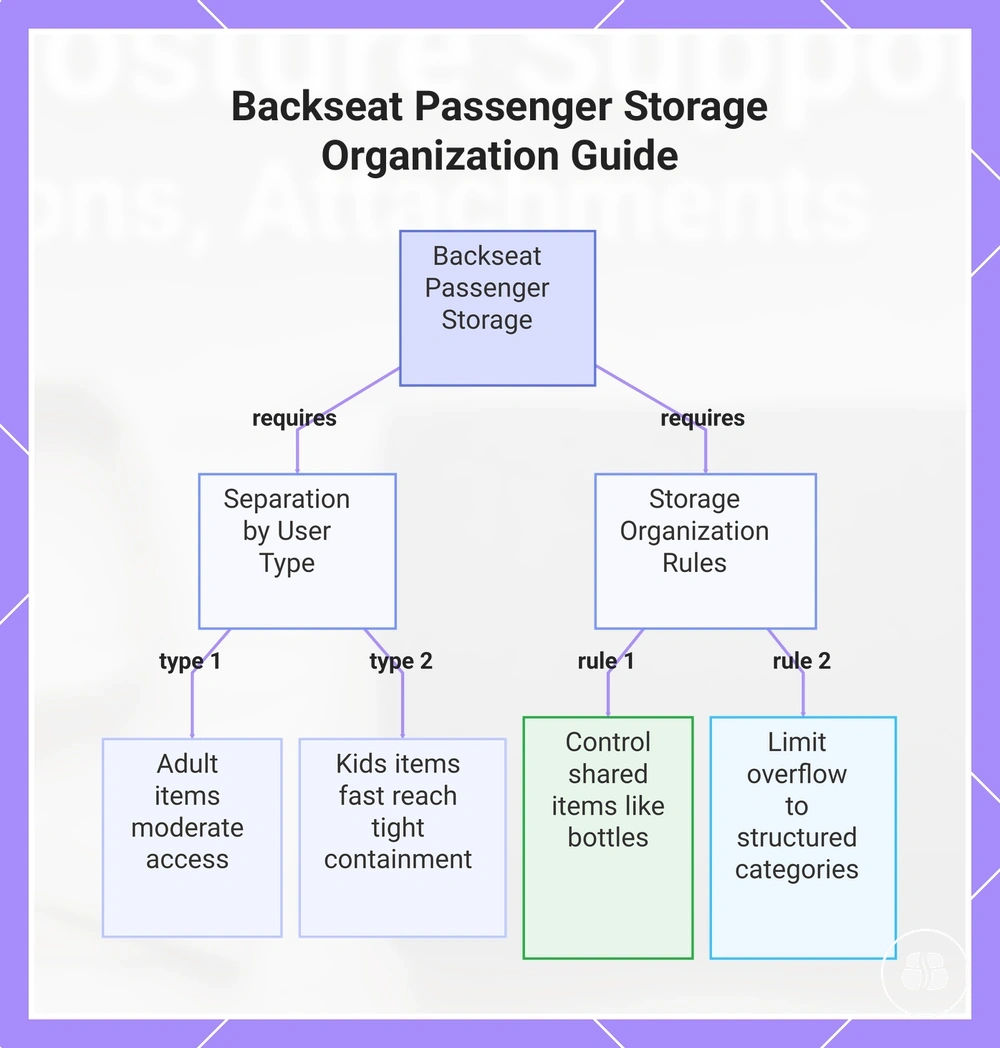
Backseat and passenger storage in a backseat organizer should separate adult passenger items from kids items based on access frequency and containment need. Adult passengers usually rely on books, travel accessories, and personal items that require moderate access, while kids items like toys, snacks, and wipes need faster reach and tighter containment. Bottles and shared passenger items should stay accessible but controlled to prevent scattering across seatback pockets. Seatback storage works best when overflow is limited and each category stays structured, helping avoid clutter buildup from loosely distributed items.
This chart shows how to separate items by user type and apply storage rules to keep the rear area organized and clutter-free.
Trunk and Cargo Storage
Trunk storage and cargo storage refer to rear vehicle space used for loading and unloading bulky, heavy, occasional, or spill-prone items. This area organizes transport items outside the main cabin flow and depends on how cargo is positioned during trips. It typically includes groceries, cleaning supplies, tools, sports items, travel bags, and emergency kits, where cargo storage supports structured separation based on usage needs.
Loading behavior directly affects cargo stability because how items are placed determines how they shift during movement in trunk storage. Loose or mixed placement can reduce stability when braking or turning, especially when groceries and heavier cargo share the same space. Separation by function helps manage different item types such as tools, travel bags, and emergency kits without interference. For example, groceries should not compete with emergency kits in the same unstable cargo storage area, as both require different access urgency and handling priorities.
- Item weight: Heavier items should be placed lower to support cargo stability
- Spill risk: Groceries and cleaning supplies need controlled positioning to reduce leakage impact
- Loading frequency: Frequently handled groceries require easier access zones
- Emergency access: Emergency kits should remain reachable without shifting other items
- Separation: Tools, sports items, and travel bags should be grouped to prevent mixing during transport
- Cargo stability: Loose movement should be minimized through structured placement
Arrange Compartments for Visibility, Access, and Stability
A driver opens different storage areas during a trip to quickly locate essential items without disrupting control of the vehicle. Items placed in poorly structured compartments often become harder to reach or visually unclear during movement. This is why compartment organization focuses on visibility, access, and stability as core outcomes.
Compartment layout is not only about where items are placed but also how those positions influence usability during motion. Shallow, divided, or layered sections can change how quickly an item is noticed or retrieved, and compartment position changes item behavior.
Effective arrangement depends on how compartments interact with item characteristics and movement conditions. Visibility improves when frequently needed items remain unobstructed, while access depends on retrieval frequency and placement logic. Stability is influenced by weight distribution and spill risk, but it can vary depending on driving conditions and load balance across compartments.
| Item or compartment | Attribute | Value or condition | Effect or decision |
|---|---|---|---|
| Compartment depth | Visibility and access | Shallow or layered design | Improves quick identification and reach |
| Divider position | Separation control | Fixed or adjustable spacing | Reduces mixing and improves structured access |
| Item height | Visibility impact | Tall or compact items | Higher items may block lower visibility zones |
| Weight distribution | Stability balance | Even or uneven load | Affects movement control during driving |
| Spill risk | Containment need | Liquid or solid items | Requires controlled placement zones |
| Retrieval frequency | Access priority | High or low usage | Determines front vs deep compartment placement |
Store Heavy, Loose, and Spill-Prone Items Low
Low placement for heavy items, loose items, and spill-prone items helps improve control during normal driving movement. Items placed closer to the base are less likely to shift or tip compared to higher positions. This arrangement can reduce shifting or tipping risk in typical storage behavior.
Item behavior in low placement depends on item weight, base stability, closure condition, liquid risk, and compartment depth. Heavy items tend to stay more stable when placed at the bottom, while loose items may shift if compartment depth is insufficient. Spill-prone items rely on secure closure and upright positioning, and movement outcome can vary depending on how evenly items are supported across the base.
Different item types require different handling cues:
- Heavy items: Place at the lowest level to support item weight and base stability
- Loose items: Use deeper sections to reduce shifting during movement
- Spill-prone items: Keep upright where closure condition and liquid risk are controlled
- Closure checks: Ensure caps or seals are secured before placement
- Compartment depth: Use deeper storage areas to support controlled positioning
Separate Clean, Sharp, Fragile, and Emergency Items
Separation of clean items, sharp tools, fragile accessories, and emergency supplies helps reduce contamination, item damage, and delayed access inside car storage. Mixed compartments often create storage conflict when incompatible items share the same space. This separation approach defines clear handling boundaries for clean items, sharp tools, fragile accessories, and emergency supplies, reducing mixed-compartment conflict during everyday use.
Separation works by assigning each group to controlled storage conditions based on sensitivity and handling needs. Clean items are kept away from sharp tools to reduce contamination risk, while fragile accessories require protection from pressure and movement. Emergency supplies need clear access paths that are not blocked by loose storage behavior, often supported by protective pouches and clear compartment boundaries. For example, wipes should be kept away from tools, and emergency items should not be stored with groceries in mixed compartments.
A compact comparison of separation logic:
| Item group | Separation reason | Compartment cue |
|---|---|---|
| Clean items | Reduce contamination and maintain separation from mixed storage | Protected or sealed compartment space |
| Sharp tools | Reduce item damage and contact risk with fragile accessories | Isolated storage with clear compartment boundaries |
| Fragile accessories | Prevent item damage from pressure or movement | Protective pouches within structured compartments |
| Emergency supplies | Prevent delayed access caused by mixed compartment storage | Clearly reachable zone with defined boundaries |
Adjust Organizer Use for Daily, Travel, Grocery, and Family Needs
Car organizer use changes with daily commuting, travel, grocery runs, and family use depending on driving pattern, passenger needs, and trip purpose. Organization shifts compartment allocation and item priority across the vehicle. This means compartment allocation and item priority change with trip purpose.
The following scenario table shows how daily commuting, travel, grocery runs, and family use affect storage behavior. The table organizes priority items, organizer behavior, and reset or reserve cues for each scenario, including kids items, cleaning supplies, tools, and emergency items as usage-based needs.
| Scenario | Priority items | Best organizer behavior | Reset or reserve cue |
|---|---|---|---|
| Daily commuting | frequent items, clean items | front access with quick reach setup | reset when routine changes |
| Travel | luggage, emergency items | compartment allocation for extended storage | reserve compartments for trip duration |
| Grocery runs | spill-prone items, bags | temporary trunk storage space usage | reset after unloading |
| Family use | kids items, cleaning supplies, tools | backseat containment and structured separation | reserve compartments for passenger needs |
Daily commuting prioritizes frequent access items, while travel requires more structured compartment allocation for longer durations. Grocery runs rely on temporary storage with spill-prone handling considerations, and family use focuses on kids items and controlled containment in shared space. Emergency items may be reserved separately depending on trip context.
These trade-offs show that organizer use depends on changing driving patterns and cannot follow a single fixed layout. Adjustments should follow trip purpose and storage needs.
The products below are useful examples for comparing available options. Before buying, check that the compatibility criteria, key features, and product details match your needs.

Daily Essentials and Commuting Items
Daily essentials and commuting items are everyday car items used during frequent driving and short trips. They are organized based on access frequency and space impact to reduce front storage clutter. These include daily essentials that need quick reach during daily commuting.
Common daily essentials and commuting items vary by access frequency and space impact, and they should be arranged to avoid front storage clutter:
- Documents: high access frequency with low space impact, typically kept within easy reach during daily commuting
- Charging accessories: high access frequency with medium space impact due to cable storage and repeated use during driving
- Tissues: high access frequency with low space impact for quick access during every drive
- Small bags: medium access frequency with medium to high space impact depending on contents and storage volume
- Water bottles: high access frequency with medium space impact due to placement stability requirements
- Sunglasses: high access frequency with low space impact for quick visibility adjustment while driving
- Cleaning wipes: medium access frequency with low to medium space impact depending on packaging and usage
Items used every drive such as documents, tissues, and sunglasses are usually kept in front storage for quick reach, while items with higher space impact or less frequent use are better kept in trunk or home storage depending on commute storage needs.
Groceries, Travel Supplies, Kids Items, Tools, and Emergency Gear
Groceries, travel supplies, kids items, tools, and emergency gear are situation-specific items that require stronger separation in car storage because they vary in size, weight, cleanliness, and access urgency. These items often enter the vehicle in mixed conditions, which increases the risk of incompatible storage when placed together. Situation-specific items therefore need stronger separation than daily essentials.
Separation is determined by size, weight, cleanliness, and access urgency to avoid conflicts between temporary and reserved storage zones. Groceries and travel supplies often require flexible trunk storage due to shifting load size and temporary use, while kids items depend on cleanliness and containment to prevent mixing with tools or cleaning supplies. Emergency gear requires higher access urgency handling, which makes compartment reservation important when overlapping with other trip items. In some situations, temporary travel supplies may be reset after use to preserve dedicated emergency storage space.
Grouped containment examples include:
- Groceries: higher weight variation and spill risk, typically kept in stable trunk storage to prevent movement
- Travel supplies: temporary items with variable size, often placed in compartment allocation zones that can be reset after trips
- Kids items: require cleanliness and containment, usually stored in controlled backseat areas to avoid mixing
- Tools: heavier and rigid items that need isolated placement due to weight and movement impact
- Cleaning supplies: sensitive to contamination and leakage, requiring separation from food-related items
- Emergency gear: defined by access urgency, kept in reserved compartments to maintain availability even when other items are loaded
Keep Car Organizers Stable During Regular Driving
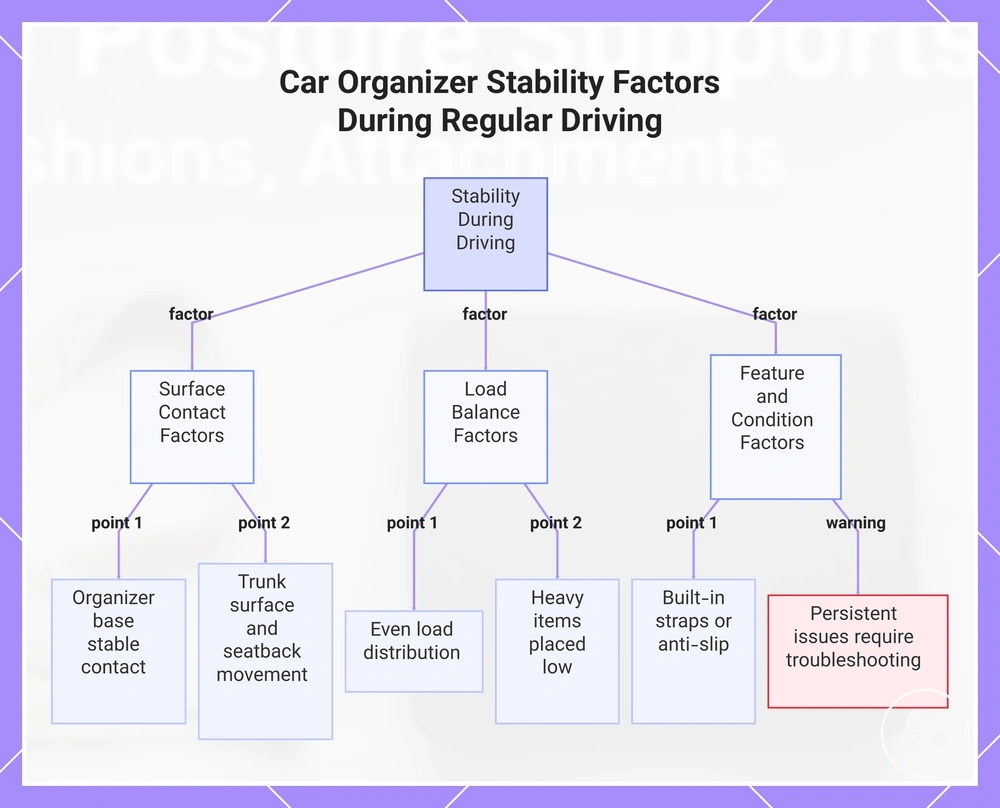
Stability during regular driving refers to how a car organizer remains steady on the organizer base without shifting, tipping, or creating blocked access to stored items. It depends on compartment load distribution, surface contact, and whether built-in straps or anti-slip features are present. Movement control is influenced by how weight is arranged across compartments during regular driving conditions, making stability a conditional routine behavior rather than a fixed outcome.
A basic stability checklist helps evaluate how placement and load behavior affect movement during use. It focuses on how surface contact, weight balance, and contact points reduce unwanted shifting. In many cases, load balance and surface contact directly influence how the organizer responds to movement and driving conditions.
- Organizer base: stable contact with the surface reduces shifting during regular driving
- Load balance: evenly distributed compartment load helps reduce tipping risk
- Heavy-item placement: lower positioning supports controlled weight behavior
- Built-in straps or anti-slip features: when present, they improve surface grip and reduce movement
- Trunk surface: uneven surfaces may increase shifting under movement
- Seatback movement: flexible contact points can affect stability in rear placement
- Driving conditions: turns, braking, and road variation influence overall stability behavior
When stability issues persist, such as continuous shifting or blocked access during normal use, it moves beyond routine stability and enters troubleshooting conditions. This section focuses only on maintaining routine stability during regular driving, not persistent slipping behavior. :contentReference[oaicite:0]{index=0}
This chart shows the key factors affecting car organizer stability during regular driving, including surface contact, load balance, and built-in features, along with a warning when problems require troubleshooting.
Prevent Clutter Buildup with a Simple Reset Routine
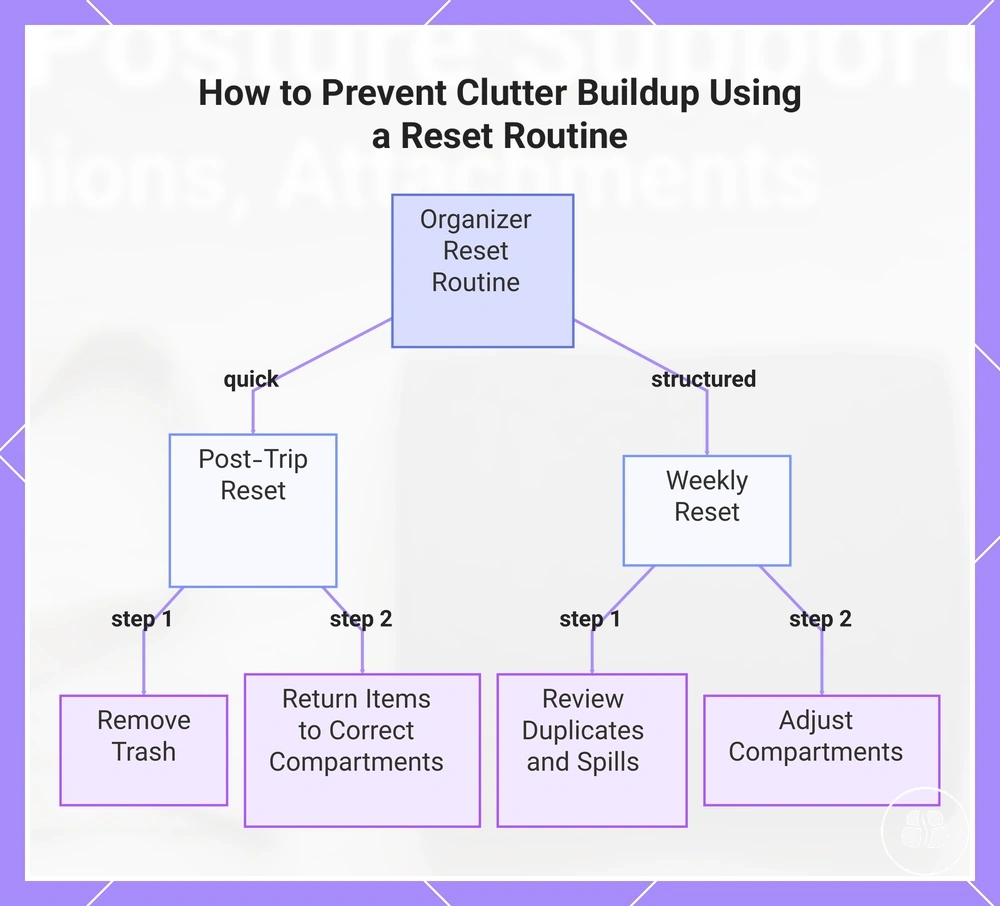
A reset routine addresses how clutter buildup occurs when items from repeated trips are not reviewed or returned to their intended compartments. After grocery runs or travel, misplaced items, spills, and duplicates often remain in the organizer and reduce usable space over time. A reset routine helps restore order after repeated trips and keeps compartments functional during regular use.
A weekly checklist helps structure the reset routine so clutter buildup does not accumulate across repeated trips. These actions focus on restoring organizer use without shifting into deep cleaning or material care tasks. The reset actions should be applied regularly after use to maintain usable compartments and reduce confusion between stored items.
- Emptying trash: remove loose waste left after repeated trips
- Misplaced items: return items to correct compartments
- Spills: check and address minor spills that affect compartment use
- Emergency items: return them to reserved compartments after use
- Duplicates: remove repeated items that increase clutter buildup
- Compartment adjustment: reorganize compartments after travel or grocery use
- Timing: perform a post-trip reset or weekly reset depending on usage frequency
A quick post-trip reset focuses on removing trash, correcting misplaced items, and returning emergency items after each trip. A weekly reset is more structured and includes reviewing duplicates, checking spills, and adjusting compartments after repeated trips. This routine supports stable organizer use without involving fabric care or deep cleaning activities.
This chart shows the two types of reset routines that prevent clutter buildup in organizers after repeated trips.
Common Car Organizer Usage Mistakes
Common car organizer usage mistakes are storage errors such as overfilling, mixing incompatible items, placing frequent items too far away, storing heavy items high, ignoring reset habits, and blocking passenger or driver comfort. These usage mistakes reduce effectiveness during regular driving and often come from storage habits rather than product defects.
These usage mistakes can be corrected by matching each problem with a practical adjustment. The table below shows how each mistake affects organizer use and what correction improves stability, access, and comfort. Each row connects a usage mistake with a specific correction and a usage-based boundary note.
| Mistake | Why it reduces effectiveness | Practical correction | Boundary note |
|---|---|---|---|
| Overfilling | Increases compartment load and blocks access | Reduce load and redistribute across compartments | May indicate limited storage capacity |
| Mixing incompatible items | Creates contamination or damage between items | Separate clean, fragile, and utility items | Check compatibility between item types |
| Frequent items too far away | Slows access during regular driving | Place frequent items in accessible compartments | May reflect layout mismatch |
| Heavy items high | Increases tipping risk and reduces stability | Store heavy items in lower compartments | Depends on load distribution |
| Ignoring reset | Leads to clutter buildup after repeated trips | Apply regular reset routine | Persistent clutter may require routine adjustment |
| Blocking passenger or driver comfort | Reduces usable space and movement control | Reposition items to restore comfort space | May indicate poor fit or layout mismatch |
Some edge cases involve slipping or poor fit, where usage adjustments alone may not fully resolve the issue. In such cases, the organizer setup may not align with the vehicle layout or load behavior. Persistent slipping or repeated discomfort can indicate the need for a different organizer configuration rather than repeated corrections.