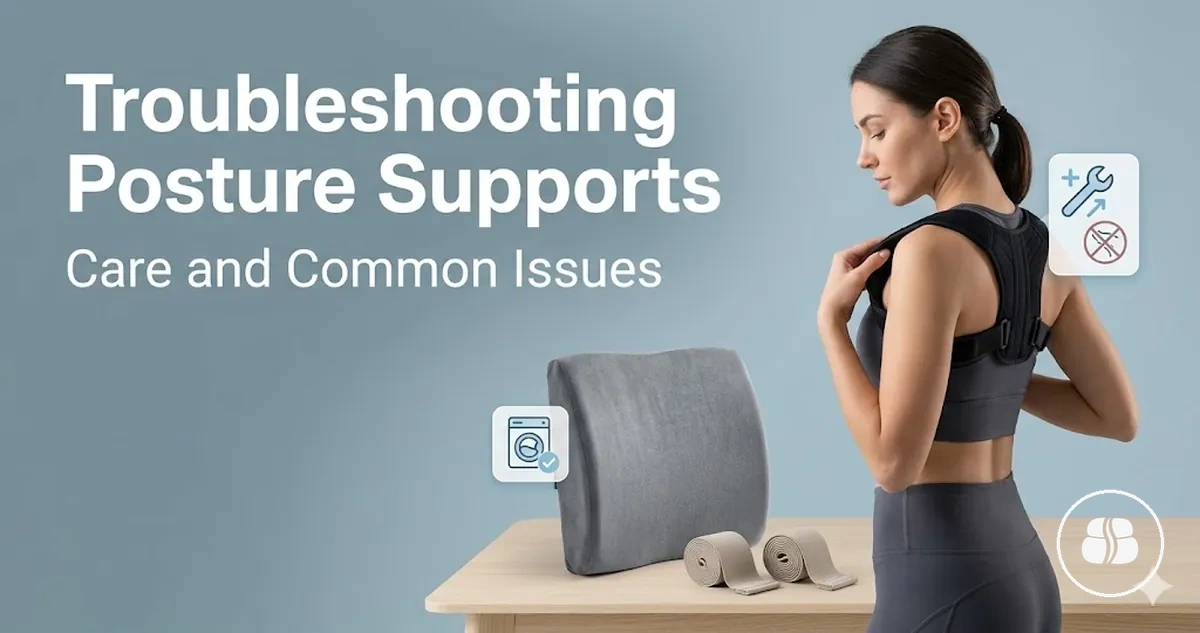
Posture support accessories troubleshooting and care
When posture support accessories cause discomfort, slipping, or tightness, the issue is often related to fit, adjustment, material contact, worn parts, or wear pattern. Many problems can be checked by loosening, repositioning, cleaning, or inspecting the accessory. Warning signs such as numbness, worsening pain, skin damage, or restricted movement should be treated as stop-use cues rather than normal adjustment discomfort.
This page stays focused on accessory troubleshooting, care, and replacement signals for posture supports, braces, straps, closures, fabrics, pressure points, cleaning, drying, and storage. For broader category context, use the Posture support accessories hub as the main boundary for related posture support accessory topics.
Symptom-to-cause checking should stay conditional because the same posture brace problem can come from more than one attribute. Slipping may involve loose straps, weak closures, clothing friction, or a poor support position. Tightness may involve excessive tension, narrow contact areas, or a fit mismatch. Odor or irritation may involve sweat, trapped moisture, fabric texture, or drying habits.
Start troubleshooting by separating body feedback from accessory behavior. Body feedback includes discomfort, pressure, rubbing, numbness, irritation, or restricted movement. Accessory behavior includes shifting, unstable support, worn straps, weak closures, fabric deformation, poor drying, or repeated readjustment.
- Fixable adjustment issue: mild pressure, slipping, or support movement may improve after loosening, repositioning, checking strap symmetry, or retesting the fit.
- Care issue: odor, moisture, fabric rubbing, or weak Velcro grip may need cleaning, drying, lint removal, or better storage.
- Replacement signal: stretched straps, broken closures, deformation, persistent slipping, or mismatch may mean the support accessory no longer behaves reliably.
- Stop-use cue: numbness, tingling, worsening pain, skin damage, or breathing discomfort should lead to pausing use and reassessing the accessory.
Problem signs in posture support accessories
Problem signs in posture support accessories should be grouped by body sensation and accessory behavior before choosing a safe next check. Discomfort, pressure, irritation, slipping, tightness, and unstable support can point to different fit signals, so the first step is to separate what the body feels from what the support accessory is doing.
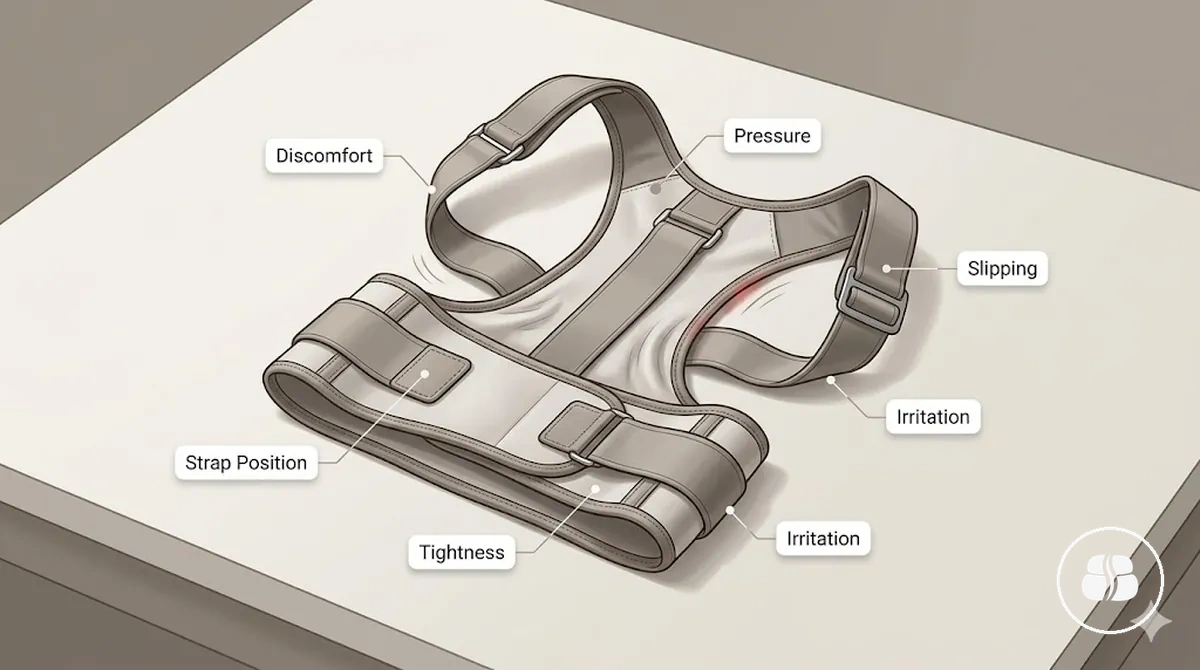
Body-signal categories include the body area affected, the pressure level, the skin response, and the duration of discomfort. A pressure point near a strap position may suggest a local fit or placement issue, while irritation near a fabric edge may involve rubbing, moisture, or contact sensitivity. Mild adjustment discomfort can happen when a wearable support is being positioned, but pain, numbness, skin damage, or restricted movement should not be treated as normal fitting feedback.
Accessory-behavior signs include slipping, shifting, uneven support movement, or pressure that changes after loosening or repositioning. A posture support accessory that moves during sitting, walking, or shoulder movement may need a fit check, strap position review, or closure inspection before more tension is added. Stronger tightness is not the default solution because excessive compression can create new warning signs.
Use this checklist to sort symptoms before moving into likely causes or fixes. The same support issue may involve fit, material, condition, and use pattern, so each sign should be checked with conservative adjustment and stop-use cues in mind.
- Discomfort by body area: note whether pressure appears near the shoulders, armpits, upper back, chest, or contact edge.
- Pressure level: check whether the sensation feels like mild awareness, pinching, excessive tightness, or restricted movement.
- Skin response: look for irritation, rubbing, redness, moisture buildup, or marks that worsen after wear.
- Support movement: watch for slipping, shifting, twisting, or unstable support during normal movement.
- Strap position: compare strap path and symmetry before and after loosening or repositioning.
- Change after adjustment: treat improvement after light loosening as a possible fit signal, but pause use if numbness, pain, or restriction continues.
Discomfort, pressure, and skin irritation
When discomfort or skin irritation appears, the cause is often related to pressure, rubbing, moisture, or wear time rather than a single accessory defect. Pressure-related discomfort usually comes from concentrated force at a contact area, while skin-contact irritation is more often linked to friction, moisture, or repeated rubbing along a fabric edge or seam position.
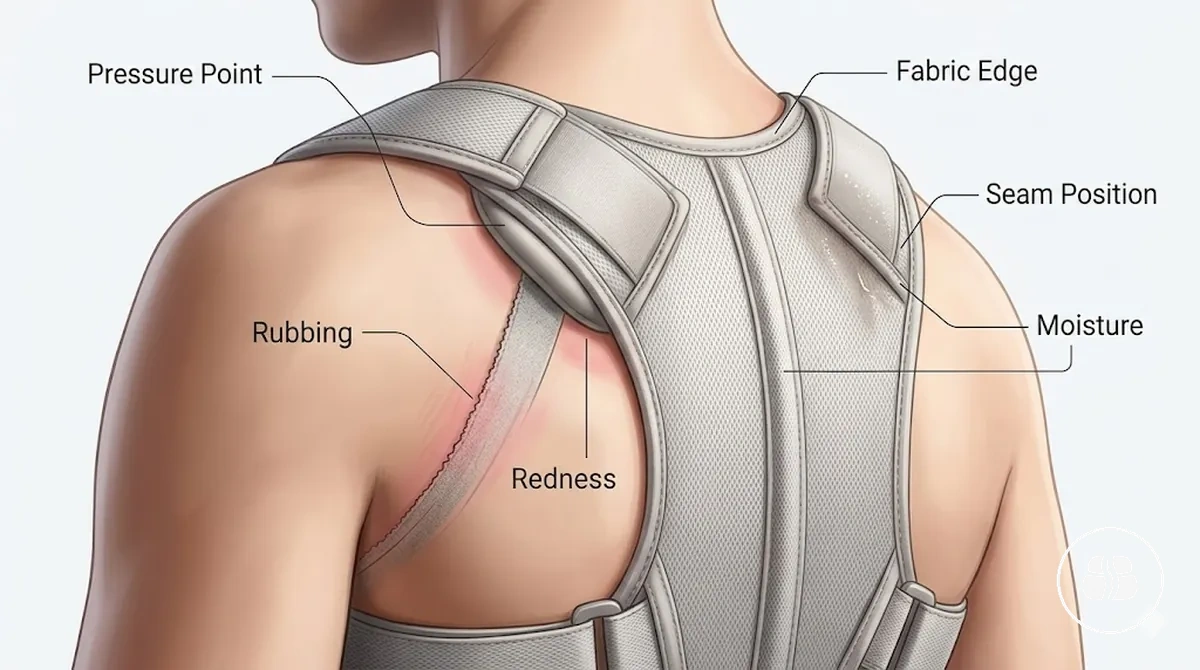
Local signs should be checked by contact area, fabric edge, and wear duration before making further adjustments.
- Contact area: look for a pressure point, soreness, or redness where the accessory touches the body most directly.
- Fabric edge: check whether rubbing occurs along a strap edge or fabric boundary during movement.
- Seam position: note whether a seam position creates repeated pressure or an uneven skin response.
- Moisture: observe whether sweat or trapped moisture increases irritation during longer wear time.
- Wear duration: compare whether discomfort appears quickly or develops after extended use.
Persistent pain, broken skin, or worsening irritation should not be treated as a simple adjustment issue. If redness, rubbing, or discomfort continues despite repositioning or reduced pressure, the situation may require stopping use and reassessing the accessory condition, fit, and wear pattern.
Armpit, shoulder, neck, and upper back pain
When armpit pain, shoulder pain, neck pain, or upper back pain occurs, strap pressure, brace tension, and placement usually need review before further use. Pain in these areas can indicate that the support accessory is pulling, compressing, or sitting in a position that creates unwanted pressure rather than stable support.
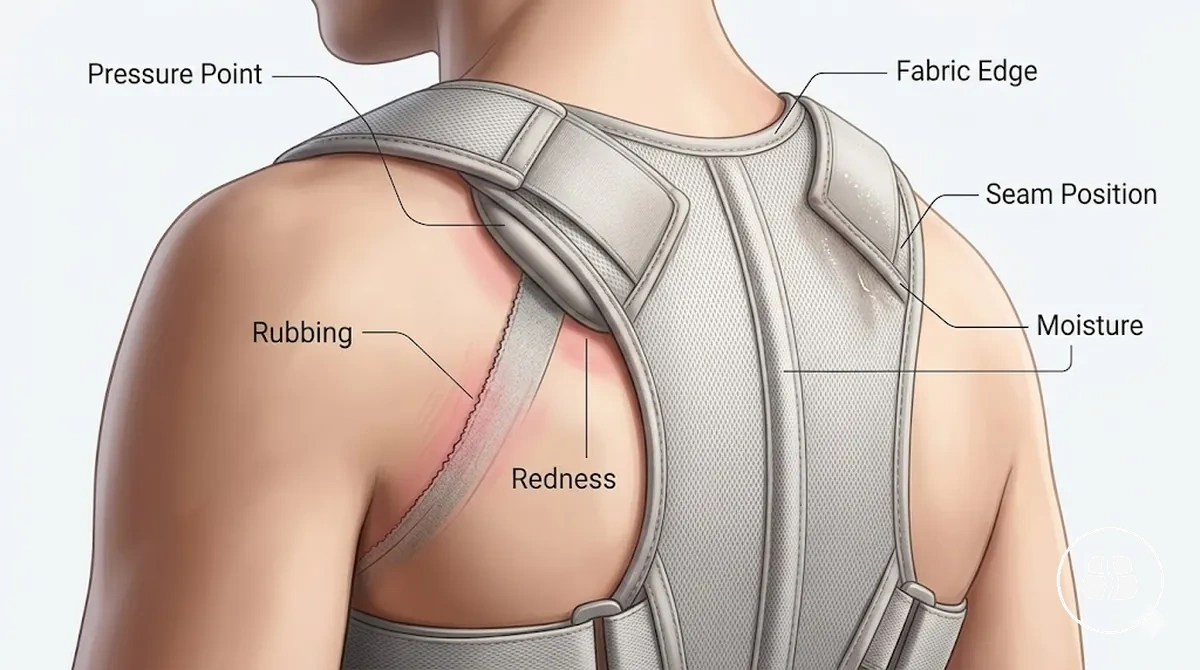
The affected area can provide clues about where support tension or placement may need attention. Changes after repositioning can help distinguish between a placement issue and a pressure pattern that continues regardless of adjustment.
- Armpit pain: may relate to strap path placement or pressure concentrated near the underarm area. Loosening or repositioning can help determine whether strap pressure is contributing to discomfort.
- Shoulder pain: can occur when shoulder pull or brace tension places excessive force across the shoulder area.
- Neck pain: may develop when poor placement encourages neck compensation or changes how the upper body carries tension.
- Upper back pain: can be associated with upper-back pressure, uneven support contact, or tension that changes after repositioning and reassessment.
Temporary pressure awareness is different from pain that continues, increases, or interferes with normal movement. If pain persists after loosening, repositioning, or reducing support tension, the accessory should be paused and reassessed rather than treated as a normal part of use.
Slipping, shifting, and unstable support
When slipping or shifting happens, the cause is often a stability problem involving support position, body movement, fabric friction, or closure condition rather than a simple need for more tension. Unstable support should be evaluated through both accessory movement and body movement because sliding during use can occur even when strap length appears unchanged.
The visible movement can help narrow the likely local condition before moving to later troubleshooting steps.
- Slipping during movement: support drift while sitting down, standing up, or walking may relate to strap length, changing support position, or torso movement.
- Shifting across a clothing layer: movement between the accessory and a clothing layer may occur when fabric friction is low and the support slides more easily.
- Moving out of place after repeated shoulder movement: unstable support may indicate that body movement is affecting support position rather than a closure problem.
- Gradual sliding despite limited movement: slipping can be associated with reduced closure grip or fastening parts that no longer hold position consistently.
- Support movement near a seat or backrest: cushion placement, chair contact, and repeated posture changes may contribute to shifting during use.
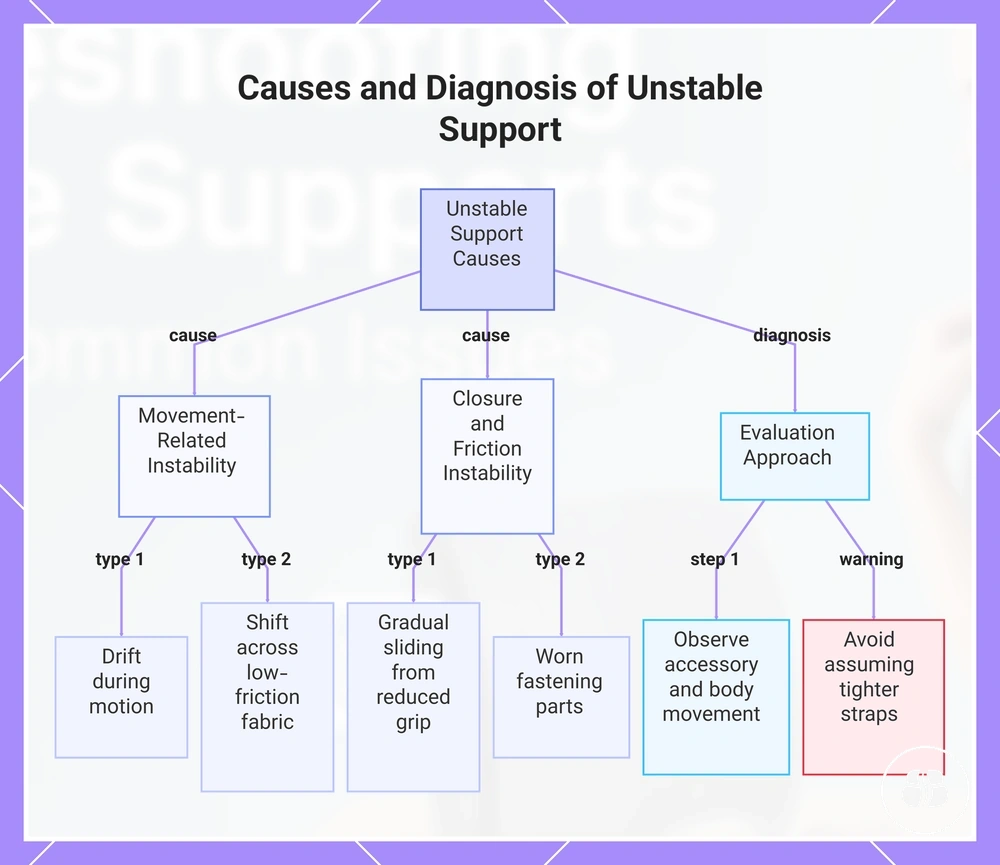
Movement-caused slipping and worn-closure slipping can look similar, but the underlying condition may differ. If unstable support changes with body movement, support position, or fabric friction, the cause may be different from slipping that continues even when movement is limited. Avoid assuming that tighter straps will solve instability, as added tension can create pressure without addressing the source of support drift.
This chart distinguishes movement-related instability from closure or friction-related instability and outlines the recommended evaluation approach to avoid misdiagnosis.
Tightness, restriction, and circulation warning signs
When restriction, numbness, or worsening pain appears, the accessory should be loosened or paused rather than treated as a sign of stronger support. Tightness should be evaluated through body feedback because stronger correction sensations can sometimes reflect excessive compression, limited movement, breathing discomfort, or reduced skin comfort instead of better support.
Caution: Warning signs may indicate that the accessory is too tight and needs reassessment.
- Numbness or tingling: circulation warning signs may appear when compression or tightness affects comfort in the supported area.
- Pinching sensation: localized pinching can indicate excessive pressure at a contact point rather than balanced support.
- Limited movement: restricted arm movement may suggest that tightness is creating unwanted movement restriction.
- Breathing discomfort: a tight brace that affects comfortable breathing is a clear stop cue and should be loosened or paused.
- Pressure marks after removal: pressure marks that remain may indicate that compression and skin comfort should be reassessed.
- Worsening pain: increasing discomfort should not be ignored and can indicate that the current tension level is not appropriate.
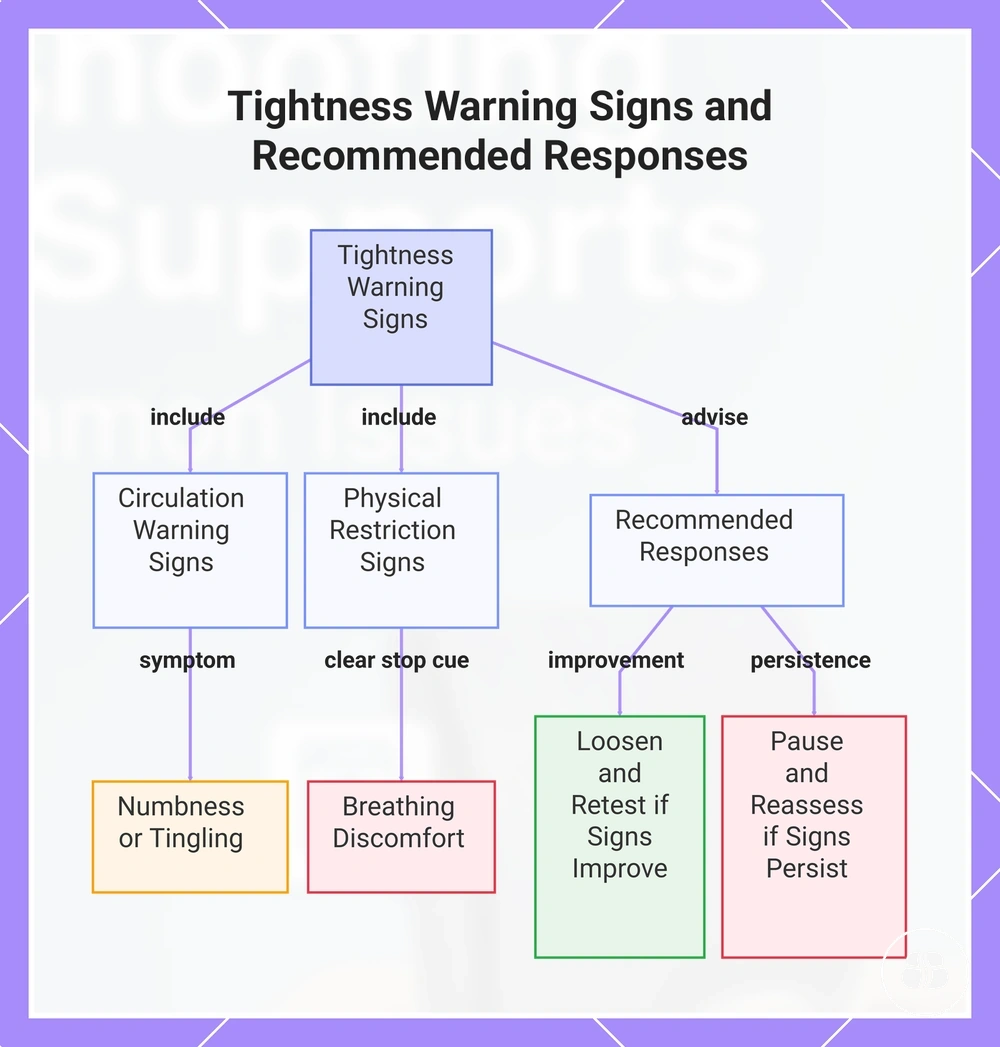
If warning signs improve after loosening, the accessory may be retested cautiously with less tension. If restriction, numbness, tingling, breathing discomfort, or worsening pain continues, pause use and reassess the accessory before wearing it again.
This chart shows the most critical warning signs of a too-tight accessory and the recommended actions to take.
Likely causes behind posture support issues
When a symptom keeps returning, the likely causes often involve strap tension, placement, material contact, moisture, closure wear, mismatch, or a combination of contributing factors. Posture support issues should be connected to a likely cause and a safe next check because more than one condition can influence the same symptom.
Symptom-to-cause thinking helps separate adjustment errors, accessory condition issues, material contact concerns, and fit mismatch signals. A symptom may point toward a likely attribute issue, but the source of the problem can overlap with other factors, so cause assignments should remain conditional rather than treated as an exact diagnosis.
| Symptom | Likely attribute issue | Check | What it means |
|---|---|---|---|
| Pressure | Strap tension or placement | Review contact areas and support position | Pressure may relate to tension distribution or placement rather than a single defect. |
| Slipping | Closure wear or support stability | Check closure grip and movement during use | Slipping may indicate reduced holding ability or changing support position. |
| Irritation | Material contact or moisture | Check skin-contact areas and moisture buildup | Irritation may be linked to material interaction, friction, or moisture conditions. |
| Tightness | Mismatch or excessive tension | Assess comfort, movement, and compression | Tightness may suggest a mismatch or tension level that needs reassessment. |
| Repeated readjustment | Placement issue or recurring mismatch | Compare support position before and after use | Frequent repositioning may indicate that the support is not remaining stable during normal movement. |
The table is intended as a cause-filtering tool, not a diagnosis. Use each symptom, likely cause, and check together to narrow the next safe check before moving to adjustment decisions, since recurring problems can involve more than one contributing factor.
Over-tightening and poor strap placement
When pressure, armpit pain, shoulder pull, or restricted movement appears, over-tightening or poor strap placement may be contributing factors. Supportive tension helps maintain position, while excessive tension can create pressure, pain, or movement restriction. A strap path that applies force in the wrong direction may concentrate brace tension on sensitive body areas instead of supporting stable positioning.
- High tension level: excessive tension may create pressure, pinching, or restricted movement.
- Incorrect strap path: poor strap placement may contribute to armpit pain or discomfort along the contact area.
- Uneven pull direction: an unbalanced strap angle may create shoulder pull or uneven pressure.
- Unstable strap anchor point: shifting at the anchor point may contribute to recurring repositioning and inconsistent support.
- Localized brace tension: concentrated force in one body area may indicate that loosening or repositioning should be considered.
Local strap checks should focus on the strap anchor point, pull direction, tension level, body area affected, and the symptom that appears when strap placement changes. If symptoms change after repositioning, strap placement may be a contributing factor rather than an accessory condition issue. If pressure, shoulder pull, or restricted movement continues, avoid increasing tension and reassess the strap path instead. For a more detailed adjustment process beyond these local checks, see How to wear and adjust posture support accessories correctly.
Friction, material sensitivity, and trapped moisture
Friction, material sensitivity, and trapped moisture describe the attribute relationship between material contact and irritation risk during wear. Fabric texture, seams, and skin contact may increase rubbing or chafing under certain conditions, while irritation risk can vary with movement, moisture state, heat, and individual material sensitivity.
When separating material, moisture, and skin-contact factors, use these attribute checks:
- Fabric texture: increased friction during skin contact may raise irritation risk when repeated rubbing occurs.
- Seams: seam contact can create localized rubbing that may increase irritation risk during movement.
- Sweat: sweat combined with fabric contact may contribute to moisture buildup and recurring discomfort.
- Heat: heat can increase trapped moisture, which may make friction and skin contact more noticeable.
- Direct skin contact: material sensitivity may influence how the skin responds to prolonged fabric contact.
Trapped moisture and material sensitivity are conditional factors rather than fixed outcomes. Humid use conditions, long wear sessions, and direct skin contact may increase irritation risk in some situations because sweat, heat, and moisture buildup can change how fabric interacts with the skin. A care response should focus on checking moisture accumulation, friction points, and recurring fabric-contact areas before assuming a single cause of discomfort.
Worn closures, stretched straps, and accessory mismatch
When slipping, uneven support, pressure, or repeated readjustment continues, worn closures, stretched straps, or accessory mismatch may be influencing how the same support accessory behaves during use. Components can change gradually over time, and visible wear may reduce stability or alter support distribution even when strap adjustments remain unchanged.
Use these inspection cues to separate component condition from adjustment-related issues:
- Velcro grip: a weak closure or reduced fastening contact may contribute to slipping during normal movement.
- Elastic stretch: stretched elastic may reduce support consistency and increase repeated readjustment.
- Buckle stability: a buckle that shifts position may affect tension retention and support balance.
- Cushion compression: compressed padding may create uneven support or localized pressure.
- Fabric deformation: stretched, twisted, or misshaped fabric may alter support positioning during wear.
- Worn fastening areas: visible wear at closure points may reduce holding strength and increase movement.
Component wear and accessory mismatch should be evaluated separately. Visible conditions such as reduced Velcro grip, elastic stretch, buckle instability, cushion compression, or fabric deformation may indicate that support behavior has changed. An accessory mismatch may be more likely when body size relation or use-case requirements remain inconsistent despite repeated adjustment, while a fixable issue may improve after correcting tension or positioning. Stronger replacement decisions should depend on both visible component condition and recurring performance problems rather than a single symptom.
Safe adjustment fixes for recurring problems
When recurring problems continue after the likely cause has been identified, safe adjustment fixes should be conservative, symptom-led, and easy to reverse. The goal is to reduce discomfort, slipping, tightness, or irritation without increasing tension or masking warning signs that may indicate a larger fit, condition, or mismatch issue.
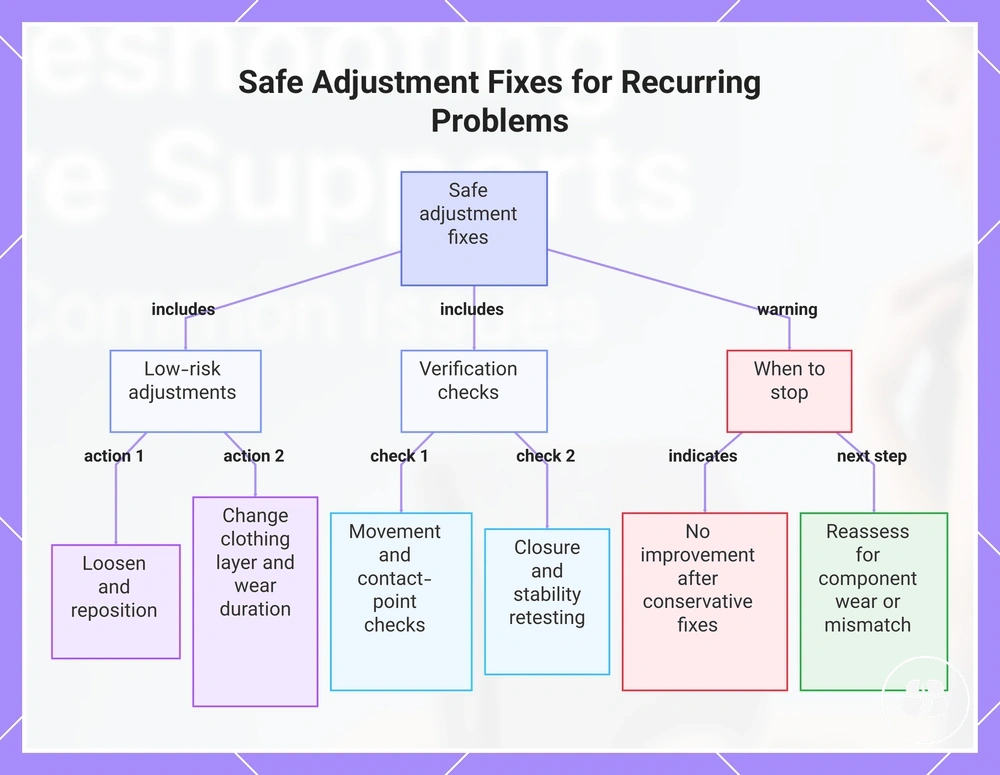
Safe adjustment fixes work best when applied in a simple sequence. Start with low-risk changes, retest the accessory during normal movement, and stop if symptoms worsen or fail to improve. Loosening, repositioning, movement testing, contact-point checks, clothing-layer changes, closure inspection, and stability retesting should come before stronger corrective actions.
- Loosen slightly and retest. Reduce tension by a small amount, then check whether pressure, tightness, or discomfort becomes less noticeable. Stop if pain or restriction increases.
- Reposition the accessory. Adjust the support position and compare comfort before and after the change. Retest during normal movement to see whether the symptom changes.
- Perform movement testing. Sit, stand, walk, or move the shoulders normally. Check whether slipping, shifting, or pressure appears only during specific movements.
- Complete contact-point checks. Inspect areas where the accessory touches the body. If irritation, rubbing, or pressure concentrates in one location, reassess positioning before increasing tension.
- Change the clothing layer. A different clothing layer may alter friction and comfort. Retest stability and skin contact after the change.
- Use a shorter wear duration. If discomfort develops gradually, reduce wear time and monitor whether symptoms improve. Pause use if discomfort continues or worsens.
- Perform closure inspection and stability retesting. Check closures for reduced grip or movement, then retest support stability during normal activity. Persistent slipping may indicate a condition issue rather than an adjustment issue.
If pain, slipping, tightness, or irritation does not improve after conservative fixes, further adjustment may not be the appropriate correction path. A recurring problem can indicate component wear, accessory mismatch, or another condition that requires reassessment rather than repeated readjustment. For more detailed fitting guidance, see How to wear and adjust posture support accessories correctly.
This chart shows the recommended sequence of safe adjustment fixes for recurring problems, including low-risk actions, verification checks, and when to stop adjusting.
Reducing pressure without losing support
Reducing pressure starts with lowering discomfort while preserving enough support for the accessory to remain useful. Pressure relief should focus on the body area affected by pressure, the current tension level, and support stability rather than loosening the accessory until it no longer maintains support position. If pressure continues or worsens, reassessment may be needed instead of repeated adjustment.
Pressure reduction should be tested through comfort, movement comfort, and support position together. A before-and-after check can help determine whether an adjustment reduces pressure without creating new slipping, shifting, or stability problems. Compare pressure level, movement comfort, and support position before the adjustment and again after retesting.
- Loosen slightly. Reduce the tension level by a small amount, then check whether pressure decreases while support position remains stable.
- Adjust the strap angle. Reposition the strap angle if pressure concentrates at a contact point, then retest movement comfort and support stability.
- Check the padding position. Move the padding position if pressure occurs near an edge or concentrated area, then compare comfort before and after the change.
- Change the clothing layer. Use a different clothing layer if friction appears to increase pressure, then retest comfort and support position.
- Reduce wear duration and retest. If pressure develops over time, use a shorter wear duration and reassess pressure, movement comfort, and support stability before extending use.
Correcting slippage without over-tightening
Correcting slippage should start with stability checks, not over-tightening. Stronger compression may create pressure while leaving the real slippage source unchanged, so stability should be checked through contact surface, strap symmetry, closure grip, clothing layer, cushion angle, body movement, and retesting after light adjustment.
Slipping often depends on placement, fabric friction, closure condition, and movement pattern. For example, repositioning the support on a smoother contact surface or correcting a shifting clothing layer may reduce slipping without stronger compression, but the result should be confirmed through movement retesting.
- Contact surface: check whether the accessory slides against skin, fabric, or a cushion surface, then observe whether surface correction improves stability.
- Strap symmetry: compare both sides of the strap path and observe whether uneven tension is pulling the support position out of alignment.
- Closure grip: check whether the closure holds after light adjustment and observe whether slipping continues despite limited body movement.
- Clothing layer: check whether the layer under the accessory increases shifting, then retest with a smoother or more stable contact layer.
- Cushion angle: check whether cushion placement or chair contact changes the support angle, then observe whether support position stays stable after sitting or moving.
- Retesting: after each light adjustment, move normally and confirm whether stability improves without new pressure or tightness.
Posture support accessory cleaning and care
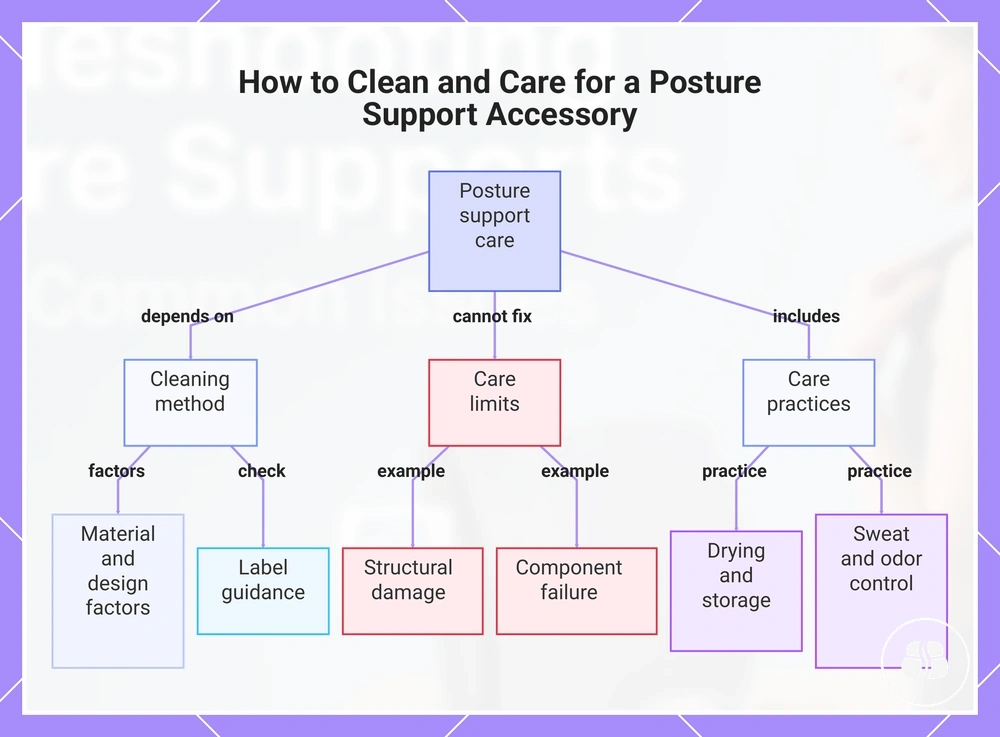
Cleaning and care are maintenance practices that help preserve comfort, hygiene, fastening performance, and material condition in a posture support accessory. Cleaning can reduce sweat buildup, odor, and surface contamination, while appropriate care may help maintain the condition of fabric, elastic, foam, straps, Velcro, and buckles.
Cleaning method depends on material type, removable parts, closure design, and manufacturer guidance. Fabric, elastic, foam, straps, Velcro, and buckles may respond differently to washing, drying, moisture exposure, and storage conditions. Cleaning and care should follow label guidance and the current material condition rather than a universal washing method, because closure performance, moisture exposure, and wear patterns can vary.
Care has clear limits. Cleaning, odor control, and proper storage may help reduce odor and irritation risk associated with sweat and moisture, but care cannot restore stretched elastic, broken buckles, damaged Velcro, torn straps, or a mismatched accessory. Structural damage and component failure require separate assessment beyond routine maintenance.
- Fabric: use a mild cleaning method that matches the material and dry appropriately to help avoid unnecessary fabric wear.
- Elastic and foam: follow material-specific care guidance and suitable drying practices to help limit avoidable stress on material condition.
- Velcro: remove lint and debris when present to support closure care and help reduce grip loss caused by buildup.
- Buckles and straps: inspect after washing and drying to help identify moisture retention, residue, or movement that may affect use.
- Sweat and odor: address moisture and odor through timely cleaning and drying rather than prolonged storage in damp conditions.
- Drying: allow adequate drying before reuse or storage to help reduce moisture-related odor and material concerns.
- Storage: keep the posture support accessory in a clean, dry storage environment to help limit moisture accumulation and support material condition.
- Label guidance: check care instructions when washing requirements differ by material, closure type, or removable components.
This chart shows the key factors for cleaning and caring for a posture support accessory, including cleaning method dependencies, care limitations, and essential practices.
Hand washing, mild soap, and removable parts
Hand washing is usually the safer cleaning method when a washable posture support accessory contains fabrics, straps, removable pads, or closures that benefit from gentle handling. The method should remain conditional because washable materials, removable parts, and closure construction can vary by care label.
Before cleaning, check the care label and identify removable inserts, removable parts, Velcro, buckles, rigid inserts, foam pads, or other components that may require separate handling. If the care label makes soaking uncertain, use extra caution with rigid inserts, foam pads, or non-soakable parts rather than assuming they can be washed with the rest of the accessory.
- Step 1: If the posture support accessory is labeled washable, review the care label and remove removable inserts only when the instructions allow; avoid assuming all removable parts are washable.
- Step 2: If hand washing is permitted, secure Velcro and other fastened closures before cleaning; avoid leaving closures open where lint or fabric contact may increase.
- Step 3: Use mild soap with cool water or lukewarm water when the care label supports a gentle wash; avoid harsh chemicals that may not suit the material.
- Step 4: Clean washable areas gently and avoid aggressive washing, prolonged soaking, or cleaning methods not supported by the care label.
- Step 5: Use gentle rinsing when rinsing is appropriate for the material and avoid twisting fabric, straps, or closures during handling.
- Step 6: Follow the care label for drying and reassembly of removable parts, and avoid treating every component as if it uses the same cleaning method.
Drying, storage, odor control, and Velcro care
Drying, storage, odor control, and Velcro care help reduce moisture buildup, weak grip, deformation, and recurring irritation because post-wash handling can affect comfort and fastening performance as much as cleaning. Proper drying and closure care focus on preserving material condition and fastening function rather than attempting to restore worn components.
Storage and odor control have practical limits. Reduced smell may indicate that moisture and residue have been addressed, but it does not confirm that the accessory is hygienically or structurally restored. If dampness, persistent smell, weak Velcro, or visible deformation continues after routine care, the condition may reflect deeper wear rather than a storage or drying issue alone.
- Air drying: use air drying with adequate airflow to help reduce moisture buildup and lower the risk of lingering dampness.
- Complete dryness: allow complete dryness before use or storage to help prevent recurring odor and retained moisture.
- Velcro care: perform lint removal from Velcro to support closure care and help reduce weak grip caused by debris buildup.
- Storage position: store flat when appropriate to help reduce compression-related deformation.
- Storage location: keep the accessory away from damp areas to support odor prevention and reduce moisture exposure.
- Shade and airflow: use a drying area with shade and airflow to support drying without relying on aggressive heat exposure.
- Decision signal: if smell, dampness, weak Velcro, or deformation persists after routine care, deeper wear may be a more likely explanation than a routine maintenance issue.
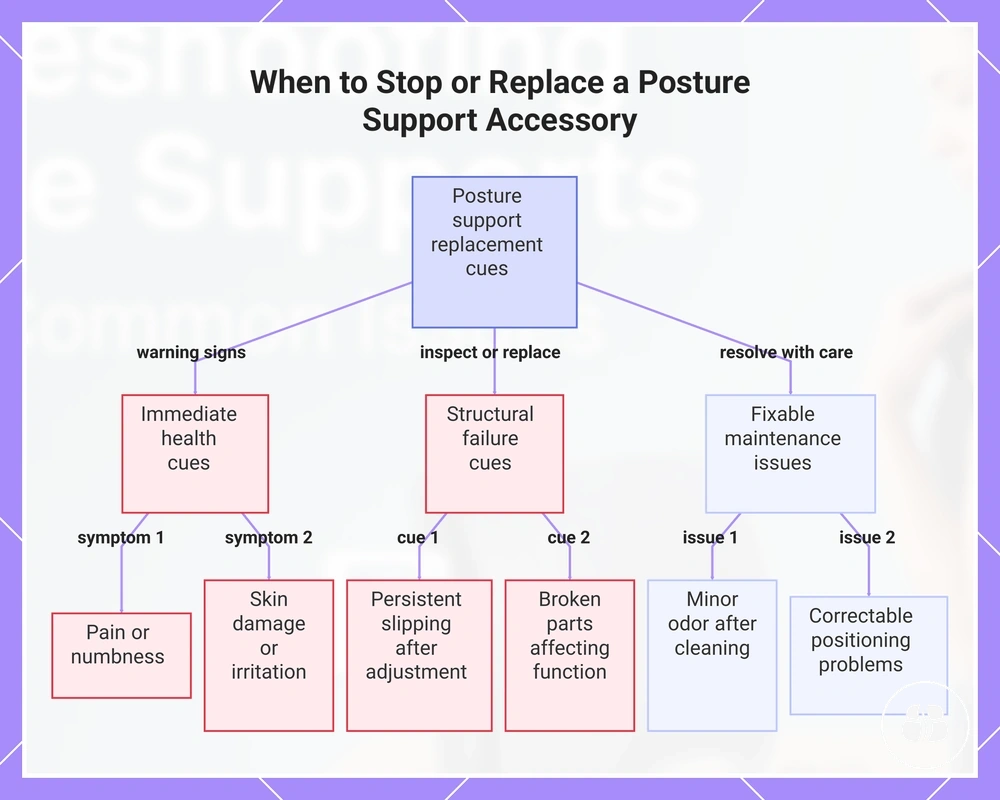
When to stop using or replace a posture support accessory
A posture support accessory should be paused, stopped, inspected, or replaced when persistent warning signs continue or when safe correction no longer restores comfort and stability. The decision depends on symptoms, accessory condition, and whether adjustment, cleaning, or routine maintenance resolves the problem without recurring issues.
Symptom-based stopping cues deserve immediate attention. Pain that worsens during use, numbness, or visible skin damage are strong reasons to stop using the posture support accessory and reassess the situation before continued wear.
- Pain or numbness: if pain increases or numbness develops, stop using the accessory and reassess before further use.
- Skin damage: if skin damage or worsening irritation appears, pause use because continued contact may increase discomfort.
- Persistent slipping: if persistent slipping continues after safe adjustment attempts, inspect the accessory condition rather than increasing tension repeatedly.
- Lost fastening grip or stretched straps: if weak grip or stretched straps affect stability, replacement may be appropriate when adjustment no longer helps.
- Broken parts: if broken parts affect function or support position, discontinue use until the condition is assessed.
- Odor after cleaning: if odor persists after cleaning and drying, inspect for deeper moisture, material, or condition issues.
- Deformation: if deformation changes fit, pressure distribution, or support position, replacement may be a reasonable replacement cue.
- Mismatch: if the posture support accessory no longer matches the intended use despite repeated correction, reassessment or replacement may be more appropriate than continued adjustment.
Fixable maintenance issues: removable lint, minor odor that improves after cleaning, or correctable positioning problems may respond to routine care and inspection. Warning signs: pain, numbness, skin damage, persistent slipping, lost fastening grip, broken parts, deformation, or a continuing mismatch are stronger signals that continued use may be inappropriate until the accessory is inspected, discontinued, or replaced.
For broader guidance on posture support accessory selection, use, care, and troubleshooting, visit the Posture support accessories hub.
This chart shows the warning signs and maintenance issues that determine whether to stop, inspect, or replace a posture support accessory.