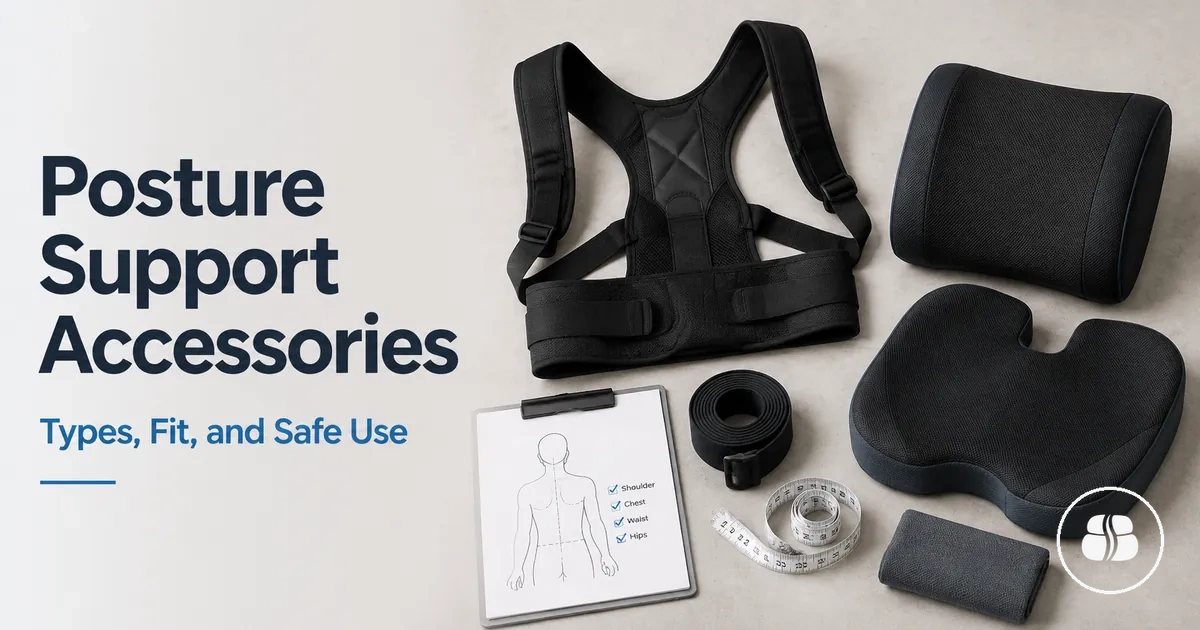
Posture support accessories overview: support types, fit, and safe use
Posture support accessories are wearable, seat-based, or chair-based aids used to support posture awareness, positioning, and comfort during everyday activities. This category includes support types that help people understand how sitting support, wearable support, fit, and safe use work together.
Accessory format changes the support role. A lumbar cushion or seat pad may change sitting contact points, while a back brace or shoulder support may give body feedback through tension, straps, or adjustment. The supported body area, chair context, wear time, and pressure response all affect whether the accessory feels comfortable, restrictive, helpful, or unsuitable. Support type only becomes useful when fit and use context match the person and activity.
Posture support accessories can help with posture awareness or comfort in some contexts, but outcomes depend on body condition, placement, duration, and body feedback. They should not replace clinical evaluation, exercise, or ergonomic correction when pain, injury, persistent symptoms, or workstation problems need more specific attention.
This overview treats posture aids as a category, not as a product list. It connects accessory formats, fit dependencies, daily-use contexts, and safe boundaries so readers can evaluate support accessories without assuming universal results.
What posture support accessories are
Posture support accessories are wearable, seat-based, or chair-based aids designed to support posture awareness, positioning, or comfort during specific activities. They are used to influence how the body or sitting surface is supported during work, rest, commuting, or other daily routines. The category includes wearable and seat-based formats.
Posture support accessories are used around specific body areas or sitting contact points rather than as general-purpose solutions. A back brace or shoulder support may provide wearable support through tension and adjustment, while a lumbar cushion or seat pad may influence comfort through contact with the lower back or sitting surface. Different accessory formats may suit different support conditions depending on fit, placement, and use context. Their role is typically connected to posture awareness, support, or comfort rather than guaranteed outcomes.
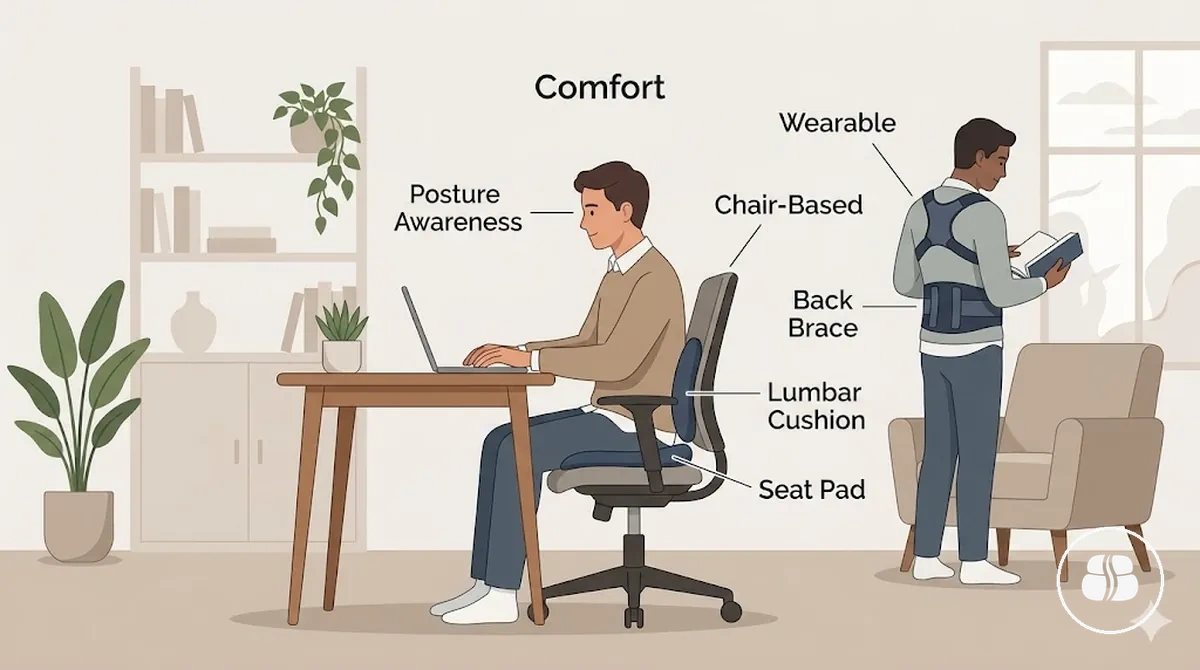
Within this category, posture support accessories include items such as a back brace, lumbar cushion, seat pad, shoulder support, and other chair-based support formats. These posture aids are intended for general support contexts and should not be confused with clinical orthotics or treated as replacements for professional advice when pain, injury, numbness, or persistent symptoms are involved.
What posture support accessories can and cannot change
Posture support accessories may influence posture awareness, positioning, comfort, or sitting setup, but their effects depend on fit, wear time, body condition, and the underlying cause of discomfort. Their support effect can vary between people, activities, and usage conditions. These factors shape both the possible benefit and the outcome limit of accessory use.
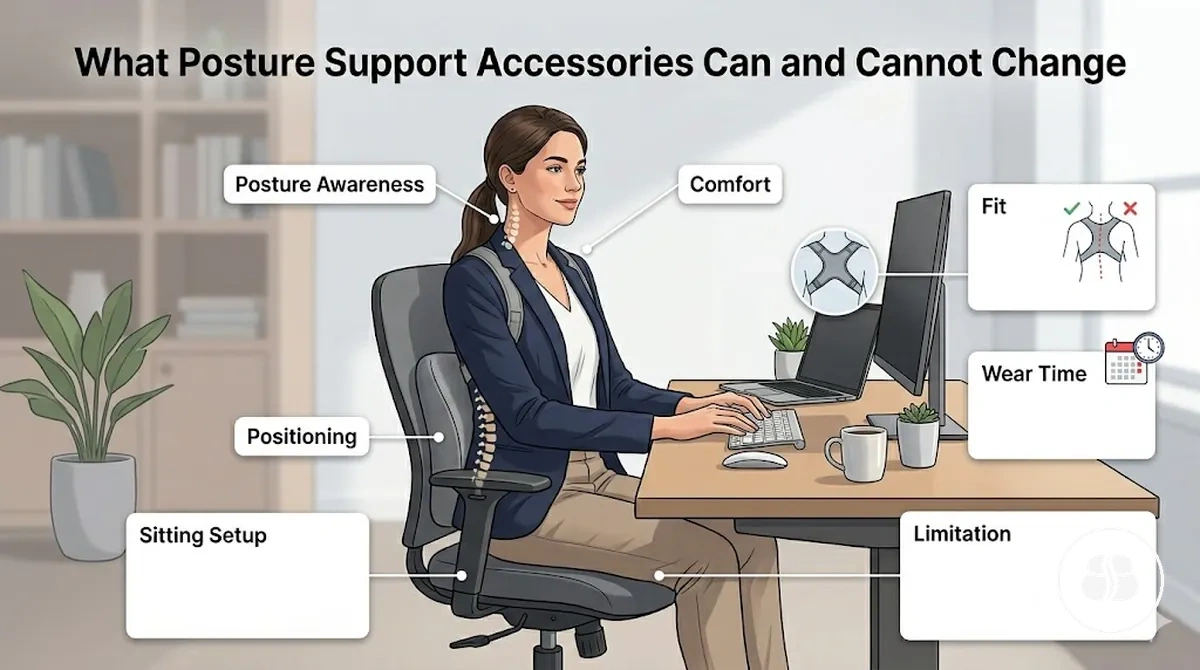
The distinction between what posture support accessories can change and cannot change helps set realistic expectations. Accessory use may support awareness of body position, encourage positioning adjustments, or improve comfort within a sitting setup during daily activities. A back support, seat pad, or similar aid may influence how a person responds to posture habits while it is being used. For a deeper discussion of support outcomes, Do posture support accessories work. Any effect still depends on fit, wear time, use context, and body condition.
Posture support accessories cannot guarantee long-term posture change, cannot guarantee the same outcome for every person, and cannot change every underlying cause of discomfort. They also cannot guarantee relief when factors unrelated to accessory use contribute to symptoms. When pain, injury, numbness, or persistent symptoms are involved, accessories should not replace professional evaluation.
A common source of confusion is the difference between temporary support, ergonomic improvement, and long-term posture change. An accessory may support posture awareness or comfort during use, while ergonomic adjustments may influence the sitting setup itself. Long-term posture outcomes often depend on broader factors than accessory use alone, creating a practical limitation and potential risk when expectations exceed what the accessory can reasonably support.
Accessory formats and their support roles
Accessory formats differ by placement, support mechanism, adjustability, and use context. Wearable supports and chair-based support formats interact with different body areas or sitting surfaces, which can change how support is experienced. As accessory formats change, their support roles often change as well.
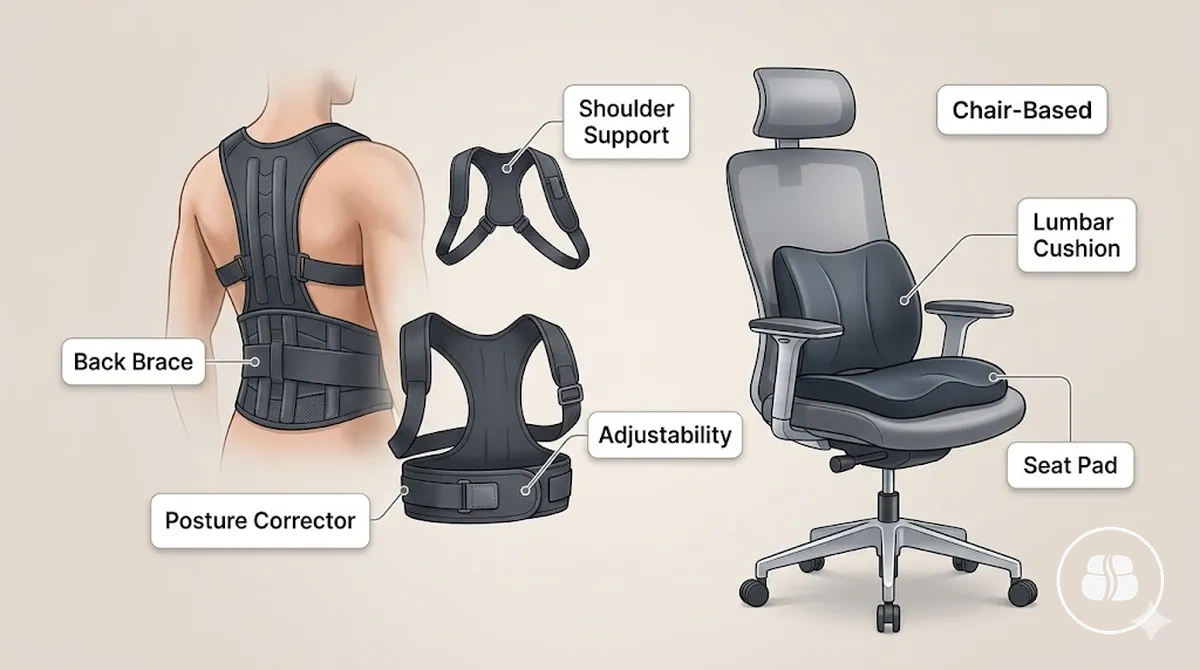
The table below groups common accessory formats by support area, firmness or adjustability, typical use context, and practical limitations. The rows are organized by support area and limitation rather than by product variation or model type.
| Accessory Format | Support Area | Firmness or Adjustability | Best-Fit Condition | Limitation or Caution |
|---|---|---|---|---|
| Back brace | Back and torso | Usually adjustable through straps or tension | When additional wearable support and positioning awareness are desired | Fit and wear time may influence comfort and support response |
| Posture corrector | Upper back and shoulders | Often adjustable | When posture awareness around shoulder position is a goal | Support effect may vary by body condition and use context |
| Shoulder support | Shoulder area | Adjustability varies by design | When localized wearable support is preferred | May not address broader sitting setup factors |
| Lumbar cushion | Lower back | Firmness varies by material and shape | When chair-based support is used in a sitting context | Comfort and positioning effects depend on placement and fit |
| Seat pad | Sitting surface | Firmness varies by construction | When pressure and seating comfort are considerations | May have limited influence on upper-body positioning |
These grouped support types provide a broad view of accessory formats and support roles without expanding into every variation. For a more detailed category breakdown, see Types of posture support accessories.
Back braces, posture correctors, and shoulder supports
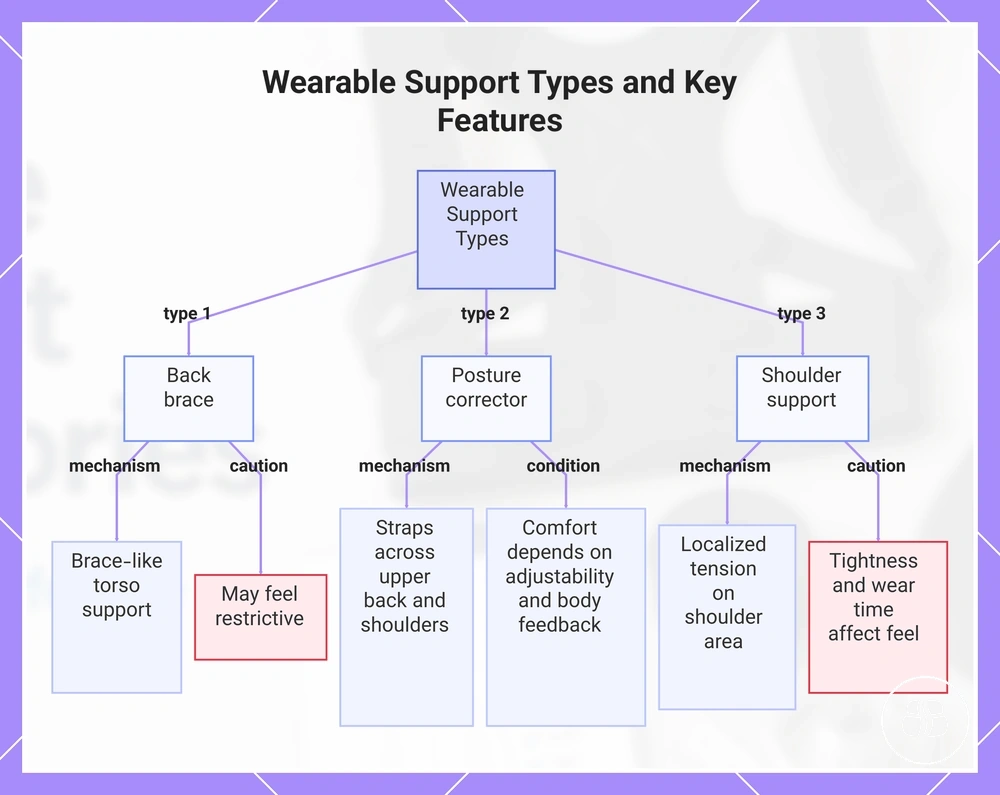
Back braces, posture correctors, and shoulder supports are wearable support formats that use straps, tension, or brace-like structures to interact with specific body areas. Their support roles differ based on placement, adjustability, and how pressure or pull is distributed across the body. A back brace may focus on torso support, a posture corrector may provide an upper-body positioning cue, and a shoulder support may target a more localized wearable support cue.
- Back brace: Uses brace-like support and adjustable tension around the torso to provide a support cue; excessive tightness or extended wear time may feel restrictive for some users.
- Posture corrector: Typically uses straps across the upper back and shoulders to create a positioning reminder; comfort and perceived support may depend on adjustability and body feedback.
- Shoulder support: Focuses on the shoulder area with localized tension and support; tightness and wear time can influence whether it feels supportive or restrictive.
- Caution: Wearable support response depends on tension, adjustability, wear time, and body feedback, so the same support type may feel different between users and situations.
This chart shows the three main types of wearable support—back brace, posture corrector, and shoulder support—their mechanisms, and factors that affect user experience.
Lumbar cushions, seat pads, and chair-based supports
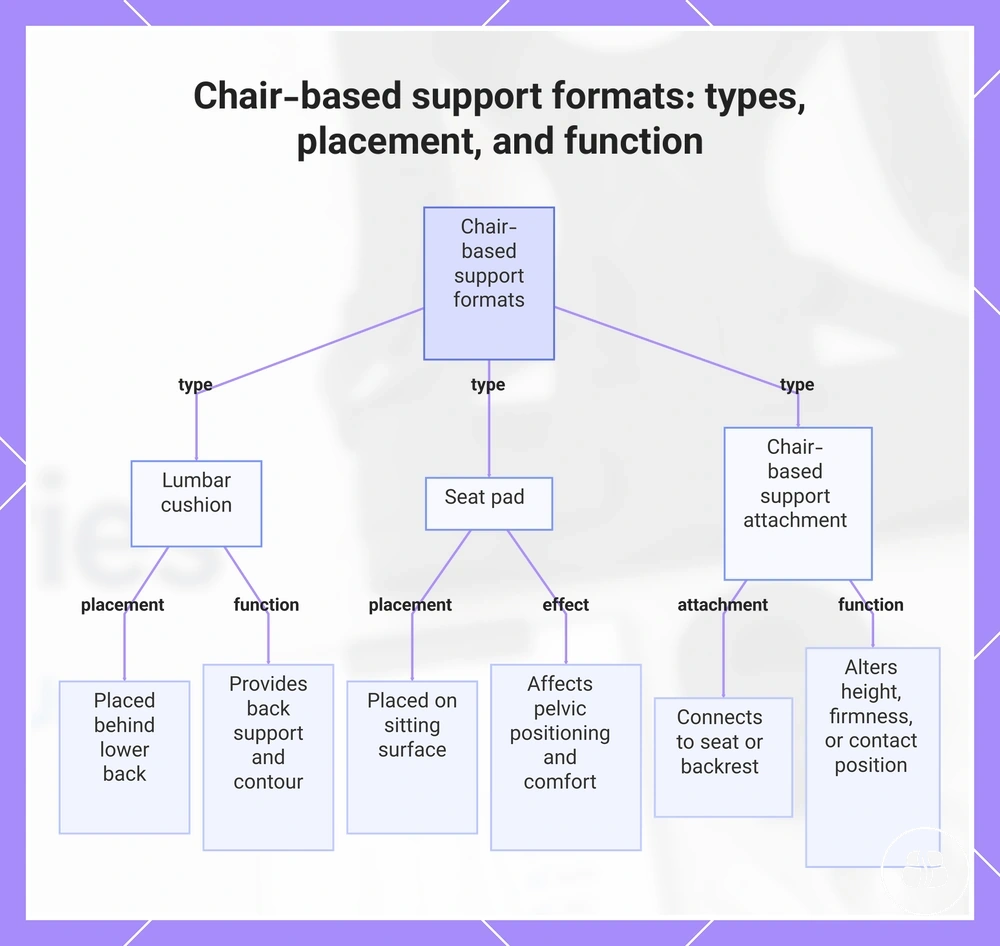
During desk sitting, car sitting, or other long seated routines, chair-based support formats can change how the body contacts the seat or backrest. A lumbar cushion may add contour to support the lower back, while a seat pad can influence sitting comfort and pelvic positioning through changes at the sitting contact points. These chair-based support formats differ mainly by placement, firmness, height, and the sitting contact point they affect.
A lumbar cushion is typically positioned behind the lower back to provide back support and contour, whereas a seat pad is placed on the sitting surface where firmness and pressure distribution may affect comfort. A chair-based support attachment may connect to the seat or backrest and alter height, firmness, or contact position. Comfort and compatibility outcomes can vary depending on seating conditions, body position, and support placement.
This chart shows the three main types of chair-based support formats and their key characteristics, including placement and effects.
Fit factors that affect comfort and support
Fit factors depend on how well a posture support accessory matches body size, placement, adjustability, firmness, chair context, and duration of use. An accessory that feels supportive in one situation may feel uncomfortable or restrictive in another when these fit variables change. The interaction between these factors often determines comfort and support.
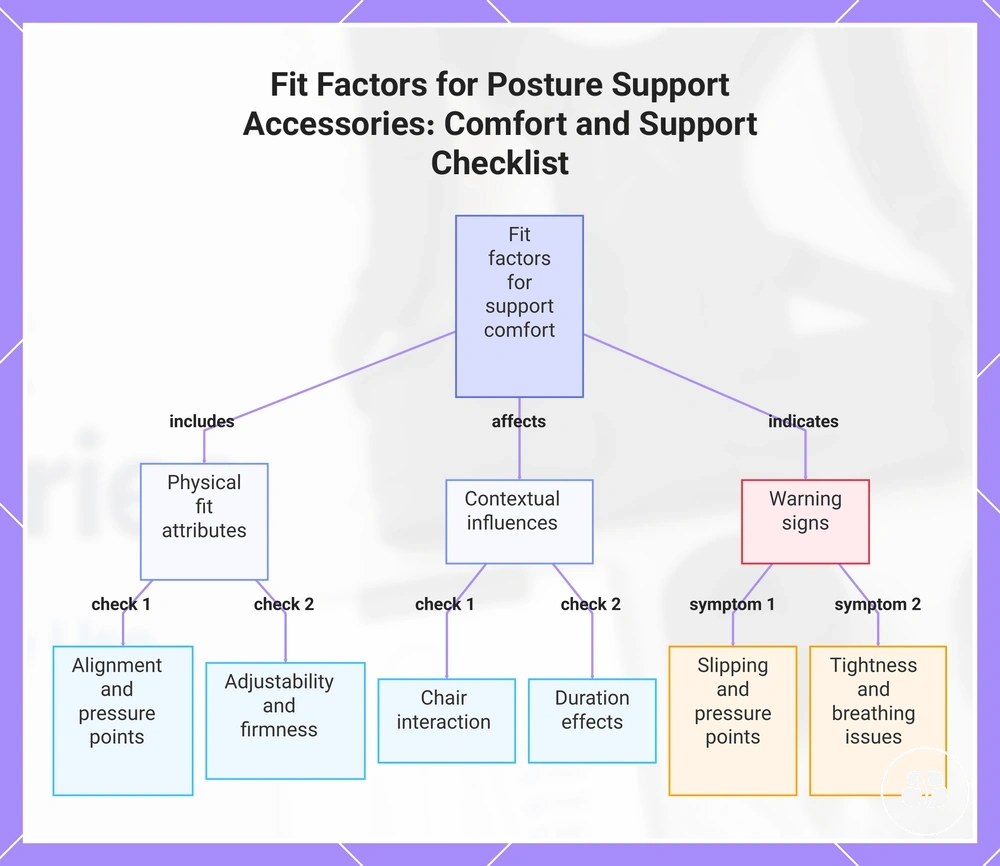
Body size, placement, adjustability, firmness, chair context, and duration influence how a support accessory feels during use. Different accessory types respond to different adjustment factors, with wearable supports relying more on placement and adjustability and chair-based supports relying more on firmness and seating conditions. A mismatch between fit variables can affect comfort signals, pressure distribution, movement, or support feel. The checklist below highlights common fit cues to assess.
- Body size: Check whether the accessory aligns with the intended support area; poor alignment may reduce comfort or support.
- Placement: Check for pressure points where the accessory contacts the body; concentrated pressure may indicate that repositioning is needed.
- Adjustability: Check straps, closures, or tension settings; excessive tightness may create discomfort or restricted breathing.
- Firmness: Check whether the support feels overly soft or overly firm; either condition may affect comfort and support.
- Chair context: Check how the accessory interacts with chair height, backrest shape, or sitting position; mismatches may affect support feel.
- Duration: Check whether comfort changes during longer periods of use; support response may vary over time.
- Slipping: Check whether the accessory remains stable during movement; slipping may indicate a placement or fit issue.
Warning signs can include persistent pressure points, slipping, excessive tightness, restricted breathing, or discomfort that increases during use. These signals may suggest that placement, adjustability, firmness, or chair context should be reviewed. For a more detailed discussion of fit variables and adjustment considerations, see Posture support accessories fit and sizing.
This chart shows the key fit variables, contextual influences, and warning signs that affect comfort and support of posture support accessories, based on a practical checklist.
Posture support for sitting, standing, and daily routines
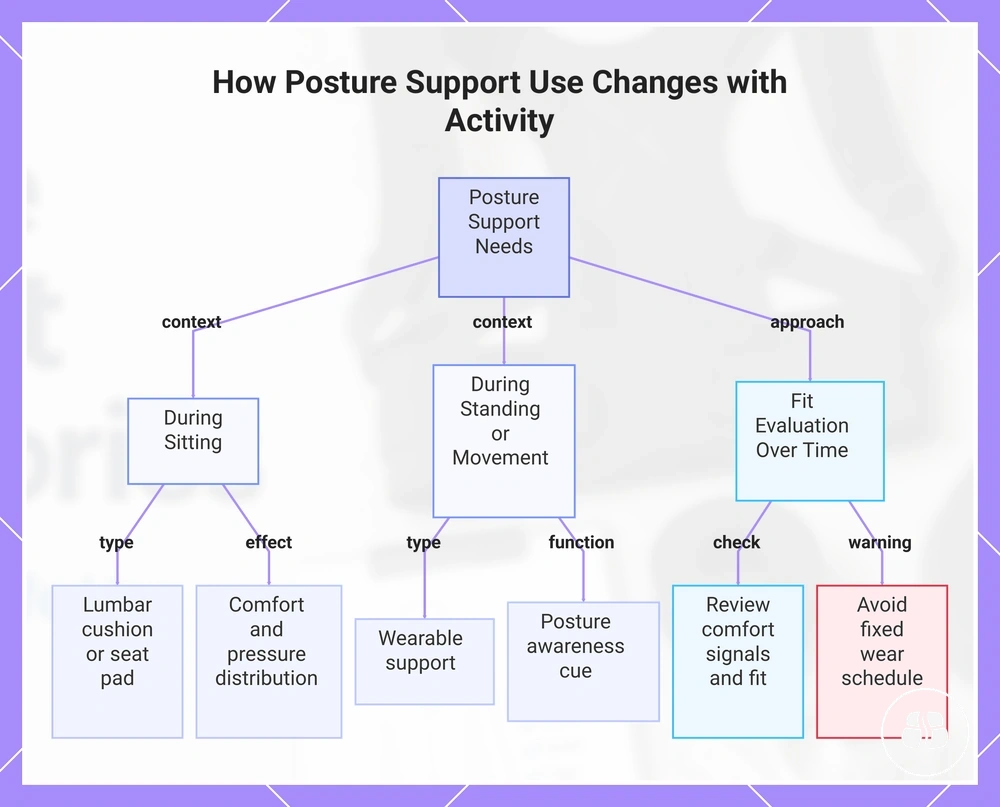
During sitting, standing, desk work, commuting, and other daily routines, posture support needs can change with activity, duration, and posture demand. A lumbar cushion or seat pad may be more suitable in a seated support setting, while a wearable support may be used when posture awareness is the primary goal during movement or standing. Use context changes the suitable accessory role.
In a sitting context, a lumbar cushion or seat pad can influence comfort, pressure distribution, and support within a chair context. During standing, wearable support may provide a posture awareness cue, although comfort and limitation can vary with duration and body feedback. Desk work often involves longer periods in one position, while commuting may introduce additional fit and pressure considerations. For readers focused on chair-specific use conditions, see Posture support accessories for office chairs. Across these situations, fit and comfort depend on the use context.
Routine use boundaries matter because comfort, awareness, and support can change across activities and over time. A support accessory that feels appropriate in one setting may feel restrictive or less suitable when posture demand, duration, or movement patterns change. Reviewing comfort signals, fit, and practical limitations can help determine whether the accessory remains appropriate without relying on a fixed wear schedule.
This chart shows how posture support accessory choice and fit depend on sitting, standing, and ongoing comfort evaluation.
Safe use limits and overuse signals
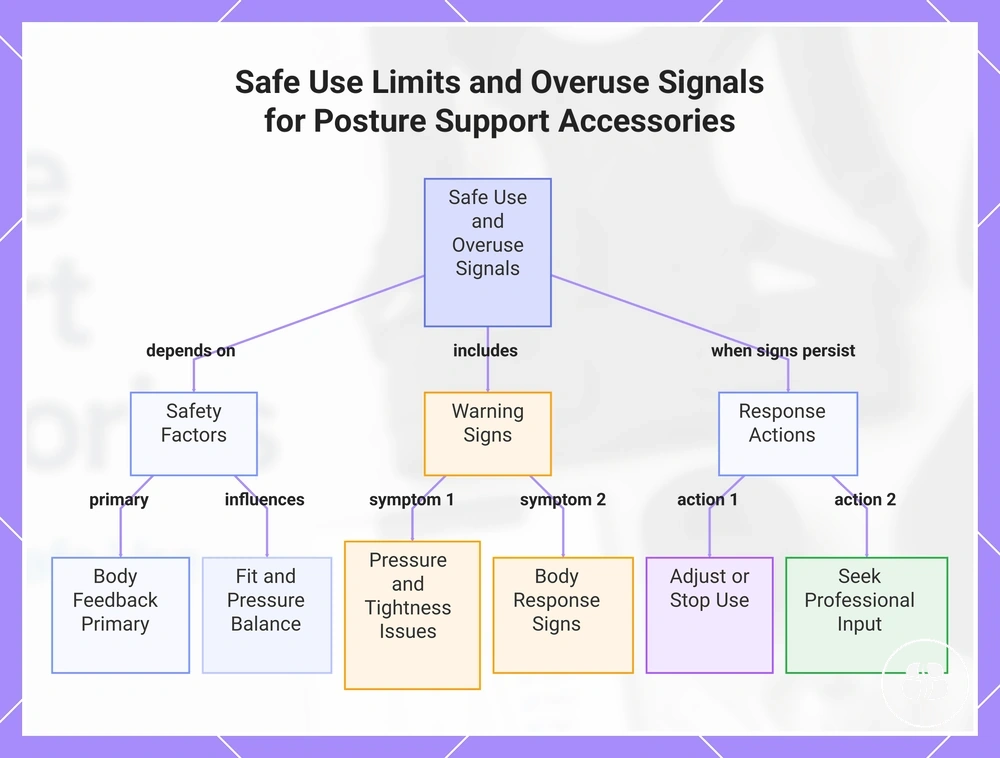
Safe use depends on body feedback, fit, pressure, wear duration, skin response, and breathing comfort. A posture support accessory may feel supportive when properly fitted, but discomfort signals can indicate that adjustment or reassessment is needed. Body feedback is the primary signal for recognizing safety limits and overuse signals.
Fit, pressure distribution, wear duration, skin response, and breathing comfort can influence whether an accessory remains comfortable during use. Excessive tightness, concentrated pressure, or poor placement may increase discomfort rather than support. Changes in skin response or breathing comfort can also indicate that an accessory should be adjusted or used differently. The warning-sign checklist below highlights common overuse cues and body feedback signals.
- Pressure: Persistent pressure points may indicate that fit or placement should be adjusted.
- Tightness: Excessive tightness can reduce comfort and may signal that the accessory is overly restrictive.
- Breathing comfort: Restricted breathing may indicate that tension or fit should be reassessed.
- Skin response: Irritation, redness, or discomfort may suggest that the accessory is not interacting comfortably with the skin.
- Numbness or tingling: These warning signs may indicate that pressure, tightness, or positioning should be reviewed.
- Circulation concerns: Unusual discomfort associated with compression may be a signal to reassess fit and pressure.
- Worsening symptoms: Increasing discomfort during use may indicate that the accessory is unsuitable for the current situation.
When warning signs persist, stopping use temporarily, adjusting fit, or reducing wear duration may be appropriate. If numbness, tingling, irritation, pain, or worsening symptoms continue despite adjustments, seeking professional input may help clarify whether the accessory remains suitable. For more detailed guidance on safety boundaries and discomfort signals, see Posture support accessories safe use and side effects.
This chart shows the main factors that determine safe use, the warning signs of overuse, and the appropriate actions to take.
When posture support accessories need a more specific comparison or selection path
A narrower selection path is needed when a decision trigger introduces meaningful differences in accessory type, use context, comfort trade-offs, fit constraints, or safety concerns. A broad overview can explain posture support accessory categories, but it may not resolve questions about which selection criteria matter most in a specific situation. When comfort limitations, compatibility questions, or fit constraints become more important, a more focused comparison path is often appropriate.
Comparison, fit, type, and safety paths address different evaluation needs. An accessory type comparison focuses on support roles and use context, while a fit check focuses on placement, pressure, comfort trade-offs, and fit constraints. Safety concerns may require closer review of safe-use limits, and chair-related questions may require office-chair compatibility evaluation. For a criteria-focused decision path, see How to choose posture support accessories. The decision-signal checklist below helps identify the most relevant narrower evaluation path.
- Decision trigger: Uncertainty between accessory formats → Relevant attribute: accessory type and support role → Narrower evaluation path: comparison of support types.
- Decision trigger: Comfort problems during use → Relevant attribute: fit constraints, pressure, and placement → Narrower evaluation path: detailed fit check.
- Decision trigger: Concerns about tightness, irritation, or discomfort signals → Relevant attribute: safety concerns and body feedback → Narrower evaluation path: review of safe-use limits.
- Decision trigger: Questions about desk work or chair use → Relevant attribute: chair context and seated support conditions → Narrower evaluation path: office-chair compatibility review.
- Decision trigger: Difficulty balancing support and comfort → Relevant attribute: comfort trade-offs and use context → Narrower evaluation path: comparison of support characteristics.
The next evaluation step depends on the specific constraint creating uncertainty. When accessory type differences are the primary concern, a structured comparison route may provide more useful information than a general overview. For side-by-side evaluation criteria and comparison routes, see Posture support accessories comparison, while fit checks, safe-use limits, or office-chair compatibility reviews may be more relevant when those factors drive the decision.
This chart maps decision triggers to the appropriate evaluation path for posture support accessories.