
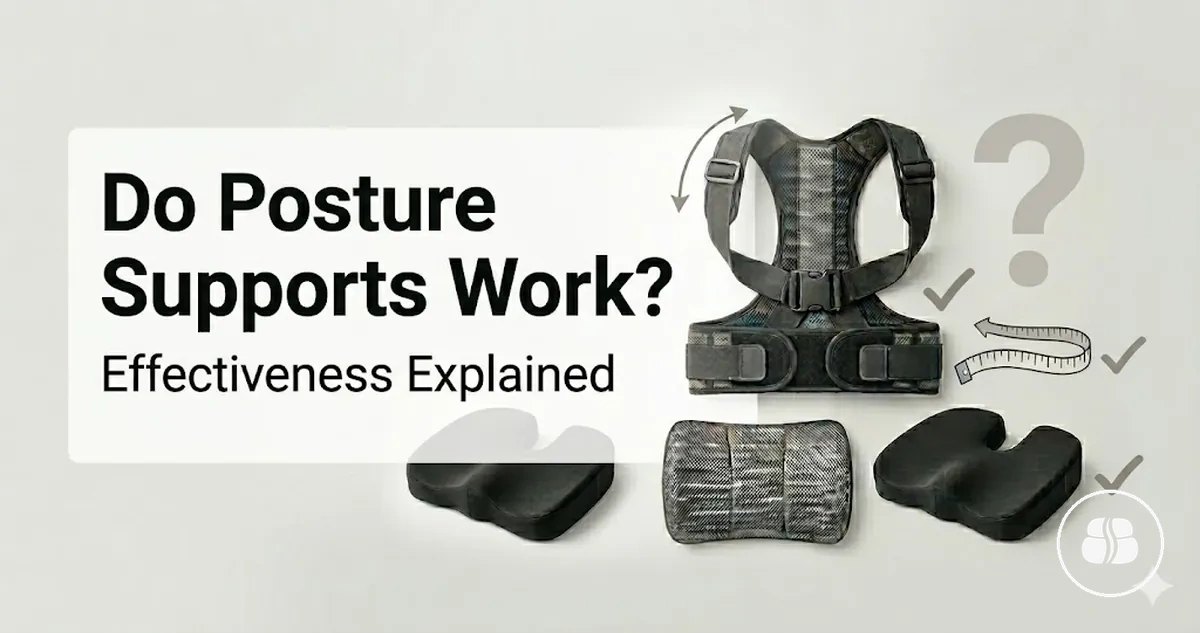
Posture support accessories effectiveness: support, correction, and limits
Posture support accessories may provide conditional effectiveness by supporting awareness, positioning, and short-term comfort when fit and use pattern are appropriate. They assist posture support during use, but they do not act as a guaranteed method of posture correction or permanent change. Their role is closer to temporary support than a cure-like correction of posture habits.
The effectiveness of posture support accessories refers to how well posture correctors, braces, and related posture support devices assist the body under specific conditions. This includes how they influence awareness, alignment cues, and comfort during everyday activities. Results vary based on fit, use pattern, comfort tolerance, and individual body condition, which all shape whether the accessory provides meaningful temporary support or only minimal effect.
In many cases, posture correctors are described as tools that can help activate underused muscles and provide feedback when the body shifts into slouched positions. This can improve posture awareness during use, but it does not automatically translate into long-term posture correction once the accessory is removed. Over-reliance or improper use can also limit perceived benefits, which is why limitations and user response are central to understanding effectiveness.
A simple example is daily desk work, where a posture support accessory may help a person notice slouching earlier and adjust their position more consciously during sitting. This type of effect is typically temporary and depends on continued use, comfort, and how the body responds over time rather than producing a fixed structural change.
What it means for posture support accessories to work
Posture support accessories work is the condition in which posture support accessories produce a useful posture-support outcome under the right conditions, meaning they create a functional support effect for posture rather than delivering permanent correction. This refers to how posture support accessories function as posture aids during use. It separates temporary support from lasting structural posture correction.
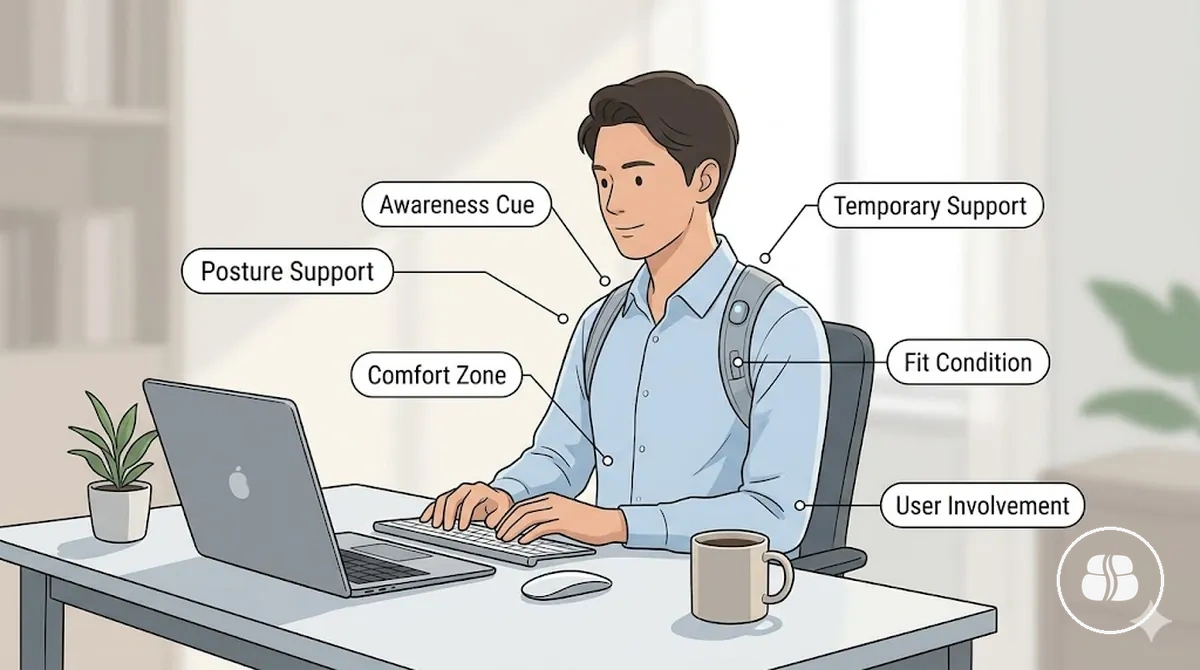
When posture support accessories work, they create a posture-support outcome that is mainly expressed through improved awareness, short-term alignment cues, and comfort during specific activities. The outcome type is not fixed and depends on duration of use and user involvement in maintaining posture habits. In most cases, this means the effect is temporary, conditional, and shaped by how consistently and appropriately the accessory is used.
Confusion often happens because posture correctors, braces, and other posture support accessories can feel helpful without producing long-term correction. The feeling of support or improved alignment does not automatically translate into lasting postural change. This distinction is important because effectiveness depends on separating comfort and awareness from actual correction outcomes.
These differences can be understood more clearly by separating the main outcome types that posture support accessories influence.
- Awareness: Helps the user notice posture changes during activity
- Comfort: Provides short-term physical support during use
- Correction: Refers to long-term structural change, which is not guaranteed
- Duration: Typically temporary and limited to usage periods
- User involvement: Required to maintain posture adjustments over time
Temporary support versus lasting posture change
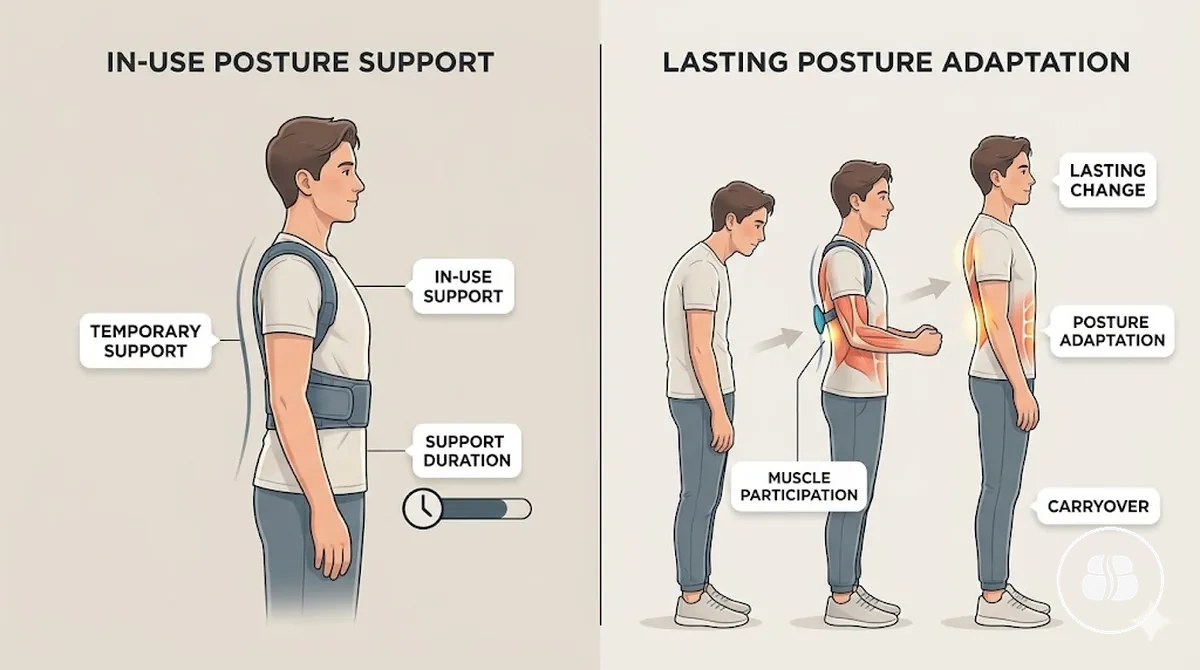
Temporary support versus lasting posture change describes the difference between in-use posture assistance and longer-term posture adaptation, where temporary support provides positioning help only during wear while lasting posture change depends on sustained muscle participation and posture adaptation over time. This distinction shows that effectiveness changes based on support duration, making duration the main divider between these outcomes.
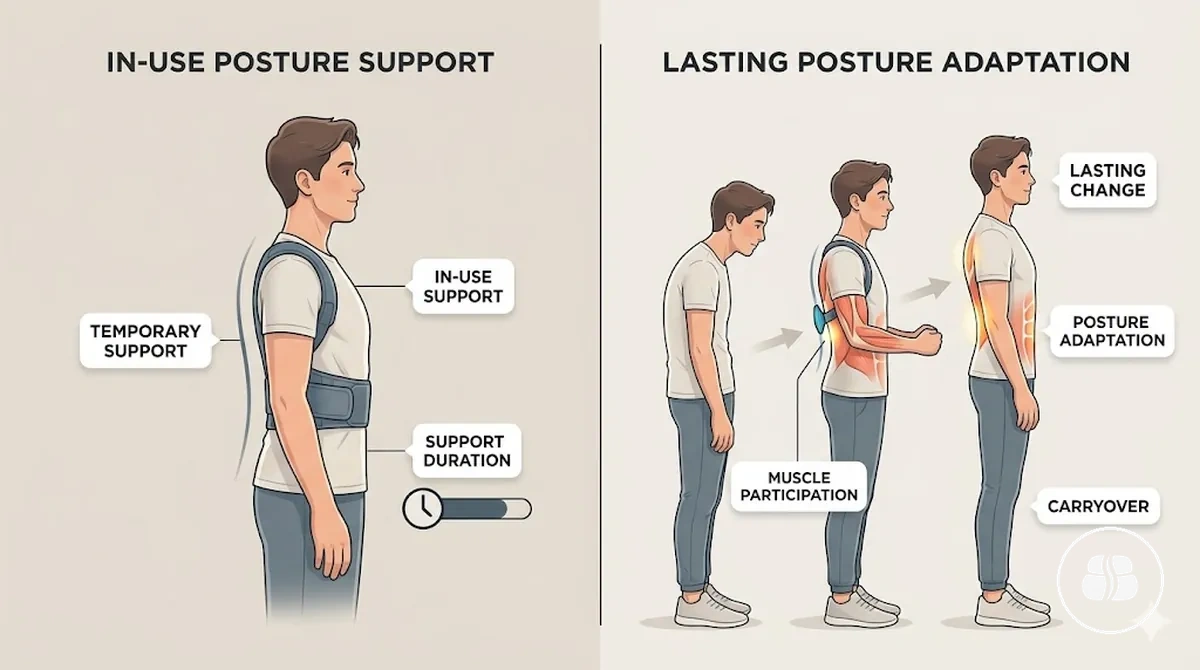
In many cases, posture support accessories create noticeable in-use support, but this does not automatically transfer into carryover after removal. Carryover depends on muscle participation, repeated posture adaptation, and how actively the user maintains posture awareness outside the device. Without these factors, the effect often remains limited to the period of support use rather than extending beyond it.
To clarify how duration changes effectiveness, the comparison below organizes temporary support and lasting posture change by their key functional attributes.
| Support type | What changes during use | What must happen for carryover | What not to assume |
|---|---|---|---|
| Temporary support | Improved positioning and awareness during wear | No carryover required; effect stays during use | Do not assume lasting posture adaptation |
| Lasting posture change | Gradual posture adaptation with active muscle participation | Consistent training and sustained user involvement | Do not assume instant or device-only correction |
Posture awareness versus physical correction
Posture awareness versus physical correction describes the difference between noticing posture through cues and reminders versus actual musculoskeletal change in alignment, where awareness reflects in-the-moment feedback and physical correction refers to structural correction over time. These two outcomes are often grouped together, but they function as separate support outcomes, and cues or reminders should not be treated as the same as correction. This distinction helps clarify how posture support accessories may influence perception without directly changing structure.
Posture awareness is mainly driven by cues, reminders, and alignment feeling created during use of a support accessory. These signals help the user notice slouching or adjust position in real time, often improving short-term control while the device is worn. However, awareness should not be treated as direct evidence of musculoskeletal change or long-term structural correction, as the underlying outcome depends on broader adaptation processes.
A common misconception is that feeling more upright automatically means physical correction is occurring. In reality, alignment feeling can exist without measurable structural correction, especially when support is externally driven rather than internally developed. This separation helps prevent overestimating the long-term effect of posture support accessories based only on immediate feedback.
Comparison of outcomes: The table below organizes how posture awareness and physical correction differ in mechanism, cues, and expected change.
| Aspect | Posture awareness outcome | Physical correction claim |
|---|---|---|
| Cues & reminders | External feedback signals during use | Not dependent on external cues alone |
| Alignment feeling | Immediate sense of upright posture | Requires sustained internal adaptation |
| Musculoskeletal change | No direct structural change implied | Involves gradual structural adaptation |
| Outcome type | Short-term awareness support | Longer-term physical adaptation |
How posture support accessories can help posture
Posture support accessories can help posture by providing external support, alignment cues, and pressure feedback that influence how the body holds position during sitting or standing. These mechanisms may create a posture support effect that improves awareness and comfort during use, but the outcome remains a conditional benefit shaped by user response, fit, and consistency rather than a guaranteed correction.
These support mechanisms work by interacting with both physical positioning and behavioral awareness. External support can reduce the effort needed to maintain an upright position, while alignment cues and pressure feedback help the user notice posture shifts in real time. Comfort change may make certain positions easier to maintain for short periods, and behavior awareness can encourage more conscious adjustments during daily activities. However, the final support outcome depends heavily on how the user responds to these signals over time.
- External support: Assists body positioning during sitting or standing
- Alignment cues: Provides signals that help detect posture changes
- Pressure feedback: Creates tactile awareness of posture shifts
- Comfort change: May influence ease of maintaining posture
- Behavior awareness: Encourages conscious posture adjustments
In everyday scenarios such as desk work or prolonged standing, these mechanisms may help users notice posture changes earlier and adjust their position more frequently. The effect is typically limited to periods of use and does not automatically lead to long-term structural change without sustained behavioral adaptation.
This chart shows the main mechanisms by which posture support accessories help posture, and the conditional factors that determine their effectiveness.
External support, alignment cues, and muscle awareness
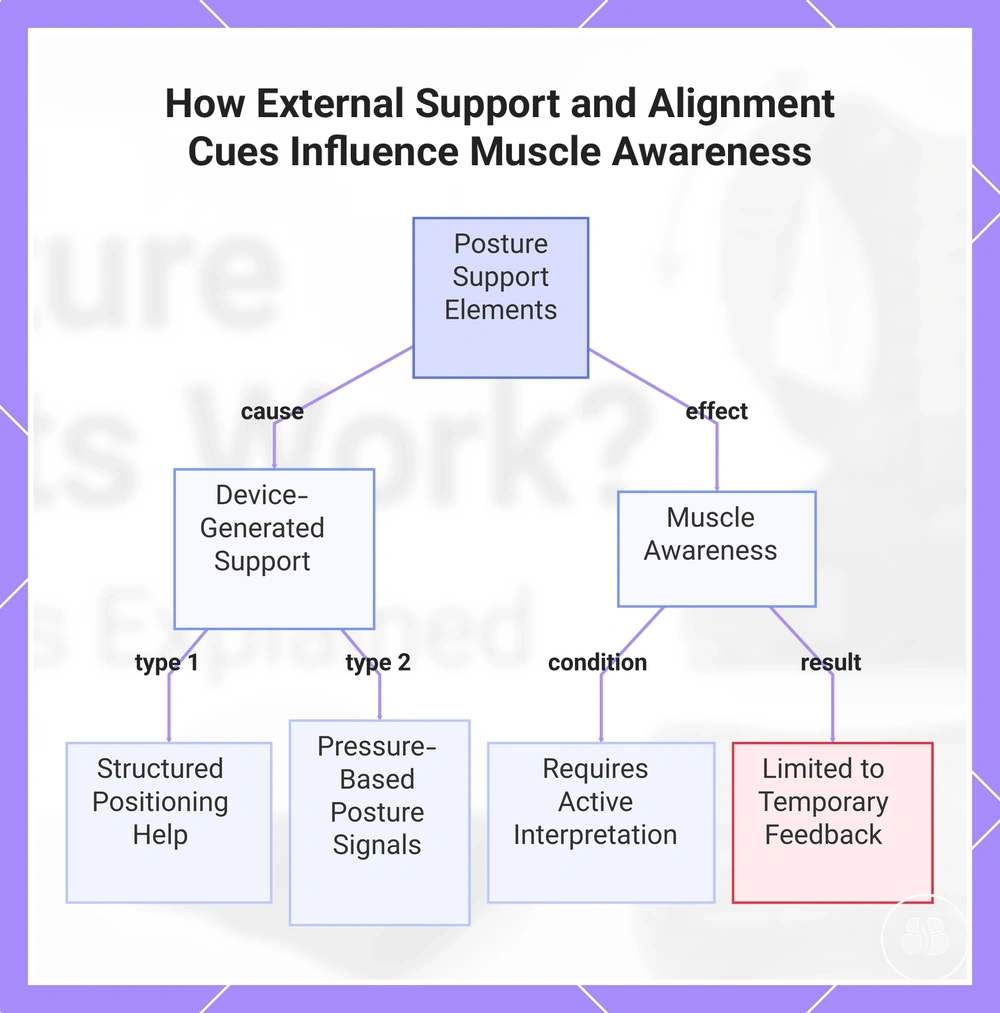
External support, alignment cues, and muscle awareness describe how posture support accessories influence body position and awareness through accessory action and body response. External support and alignment cues are generated through the device’s structure, while muscle awareness emerges only as a response shaped by tactile feedback and user response. This response is conditional because muscle awareness is not automatic and depends on use condition and how the body interprets signals during wear.
External support helps guide body position by providing structured positioning help, while alignment cues create pressure-based signals that indicate posture shifts. These cues and tactile feedback work together as a support signal that influences posture behavior during use, but they do not independently create adaptation in muscles.
Muscle awareness depends on body response rather than accessory action alone. In many cases, the support signal can highlight posture changes, but the awareness outcome varies based on user response and use condition. Without active interpretation by the body, the effect remains limited to temporary feedback rather than automatic strengthening.
This chart shows how device-generated external support and alignment cues interact with the body's muscle awareness response, and the conditions that determine its effectiveness.
Comfort, relief, and confidence as conditional benefits
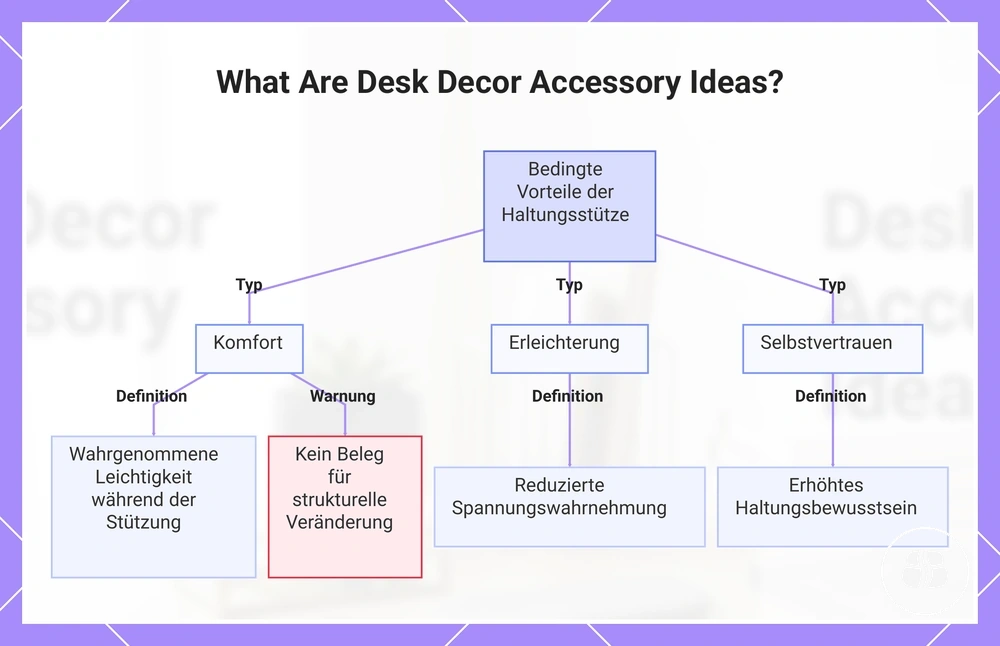
Comfort, relief, and confidence describe conditional benefits that may appear during the use of posture support accessories, but they do not indicate proof of changes in posture mechanics. These benefits are based on user perception and trigger condition, and they vary depending on fit, context, and how the body responds during use. Their effect remains limited to supportive experience rather than structural change.
These benefits occur when external support influences posture positioning, but they must be separated from posture mechanics to avoid misinterpretation. Comfort may reflect perceived ease during supported positions, relief may relate to reduced tension perception in specific conditions, and confidence may come from improved posture awareness while using the support. Each outcome depends on user perception and does not confirm long-term physical adaptation.
- Comfort: Perceived ease during supported posture positions
- Relief: Reduced tension perception under certain trigger conditions
- Confidence: Increased posture awareness rather than structural change
A key limitation is that improved comfort alone should not be used as evidence of changes in posture mechanics. These conditional benefits can support short-term user experience, but they remain distinct from structural outcomes and must be interpreted within user perception and context of use.
This chart shows the three conditional benefits (comfort, relief, confidence) and the key limitation that they are perceptual and not evidence of structural posture change.
When posture support accessories are more likely to be useful
Usefulness of posture support accessories increases when there is a mild posture issue combined with a clear need for useful support rather than structural correction. In these cases, the accessory may provide cue-based assistance and temporary posture awareness, and this forms the main criteria for evaluating when they are appropriate to use. :contentReference[oaicite:0]{index=0}
Criteria such as fit quality, adjustment, use duration, comfort tolerance, and active posture habits directly influence the support effect. When fit quality and adjustment are stable, the accessory can better deliver consistent alignment cues, while suitable use duration and higher comfort tolerance may improve sustained usage during daily activities. Active posture habits outside the device further shape the outcome, but results still vary and are not guaranteed even when multiple conditions are met.
In situations involving more severe posture issues, persistent discomfort, or unclear underlying causes, relying only on posture support accessories may not be sufficient. These cases often require professional advice or an alternative approach to ensure appropriate handling of the underlying issue. Decision-making should be based on observed response and context rather than expectation of a universal solution.
Usefulness is more likely when these conditions are present:
- Mild posture issue with temporary support needs
- Expectation focused on posture awareness rather than correction
- Fit quality that allows stable positioning without discomfort
- Adjustment that maintains consistent alignment during use
- Comfort tolerance suitable for regular short-term use
- Use duration aligned with daily activity periods
- Active posture habits supporting awareness outside the device
This chart shows the conditions under which posture support accessories are most useful, the criteria that influence their effectiveness, and when they should be avoided in favor of professional advice.
Mild slouching and temporary desk support needs
Mild slouching and temporary desk support needs refer to situations where mild posture severity combines with short-term sitting duration and task type demands, making useful support more plausible in a limited context. In these conditions, posture support accessories may provide temporary desk support focused on alignment cues and posture awareness rather than structural correction, and the expected outcome remains conditional on the support need and usage context.
For example, during routine desk-based tasks involving light computer work or reading, a person with mild slouching may experience temporary desk support that helps maintain awareness of posture shifts during sitting duration. In this scenario, the support need is primarily cue-based, and the expected outcome stays limited to short-term posture awareness without extending into workspace optimization or permanent change.
This chart defines temporary desk support needs for mild slouching, including the required conditions, support functions, and expected outcome.
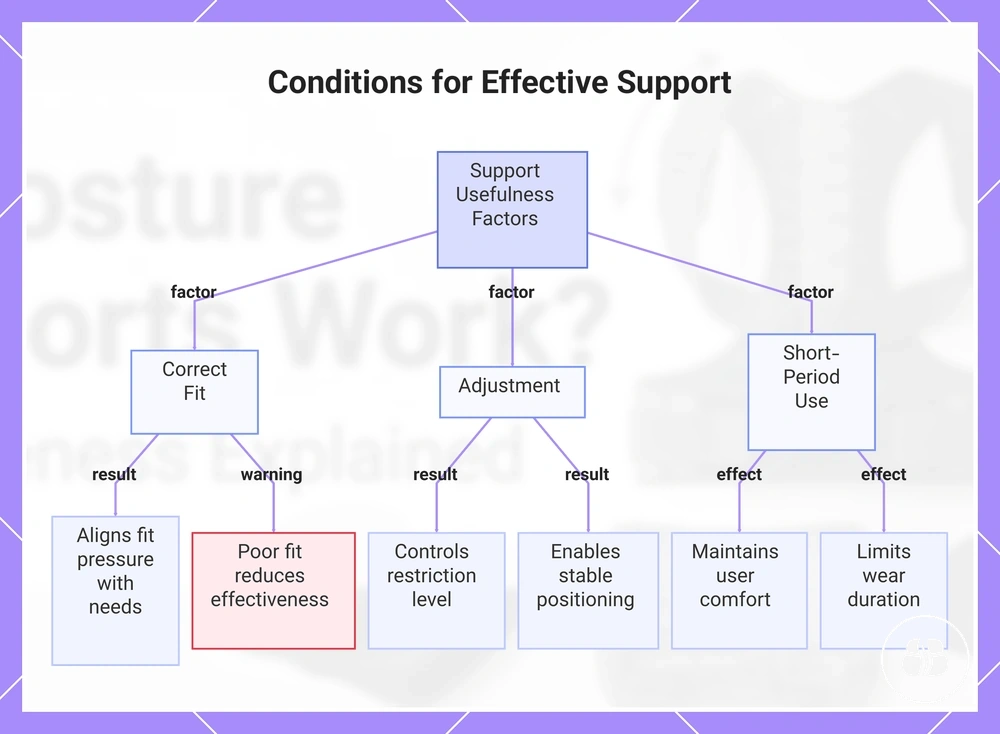
Correct fit, adjustment, and short-period use
Correct fit, adjustment, and short-period use influence whether support feels useful because these factors directly affect fit pressure, adjustability, restriction level, wear duration, and user comfort during wear. In practice, usefulness depends on how well these conditions align with mild usage needs, and poor fit can make an otherwise relevant accessory ineffective or uncomfortable even in suitable situations.
When fit pressure is balanced and adjustment allows stable positioning, short-period use may support more consistent comfort and clearer restriction level control during activity. Wear duration also shapes how the body responds, as user comfort can decrease when support is misaligned or too restrictive, leading to reduced effectiveness over time. If poor fit occurs, the support outcome may drop significantly even when the intended use case is appropriate.
These criteria can be summarized as follows:
- Correct fit aligns fit pressure with mild support needs
- Adjustment controls restriction level and stability during use
- Short-period use helps maintain user comfort during limited wear duration
- User comfort determines whether support remains usable in practice
- Poor fit may reduce effectiveness and increase discomfort risk
This chart shows the three main factors that determine whether a support feels useful: correct fit, adjustment, and short-period use, along with their specific effects.
Why posture support accessories do not work for every posture problem
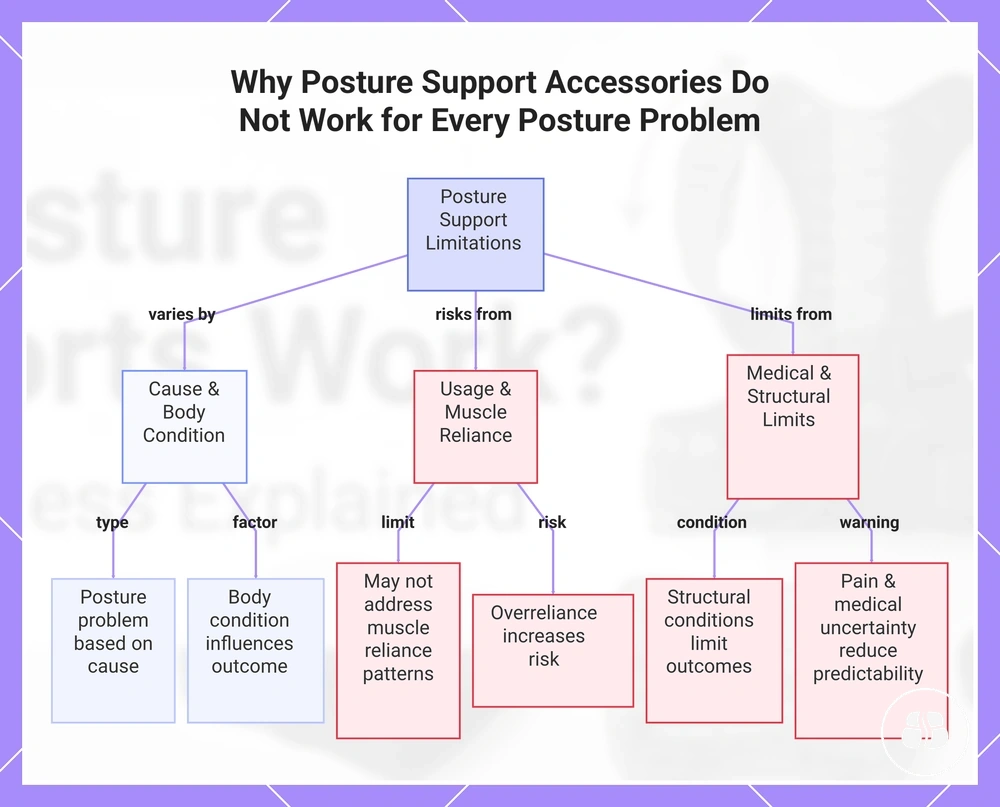
Posture support accessories do not work equally for every posture problem because their limitations depend on cause, body condition, and usage behavior. Different posture problems respond differently to passive support, especially when muscle reliance patterns or underlying structural conditions shape the outcome. This creates variation in effectiveness rather than a uniform result across all cases.
In many situations, passive support may provide temporary alignment cues, but it does not always align with the actual cause of the posture problem. When usage behavior leads to overreliance, muscle reliance can increase instead of improving independent control. These limitations become more visible when expectations do not match the support role of the accessory, especially under overuse risk or incorrect application of support.
In cases where pain signals, structural conditions, or medical uncertainty are present, the effectiveness of posture support accessories becomes less predictable. These factors cannot be reliably interpreted through accessory use alone, and they may require cautious reassessment of both body condition and usage behavior. In such contexts, passive support should be evaluated carefully rather than assumed to produce consistent results.
To clarify the boundaries of effectiveness, the following points highlight key variation factors:
- Posture problem varies based on cause and body condition
- Passive support may not address muscle reliance patterns
- Usage behavior can increase overuse risk over time
- Structural conditions may limit expected outcomes
- Pain signals require cautious interpretation of effectiveness
- Medical uncertainty reduces predictability of results
This chart shows the key factors that limit the effectiveness of posture support accessories based on cause, usage, and medical conditions.
Passive support, muscle reliance, and all-day wear limits
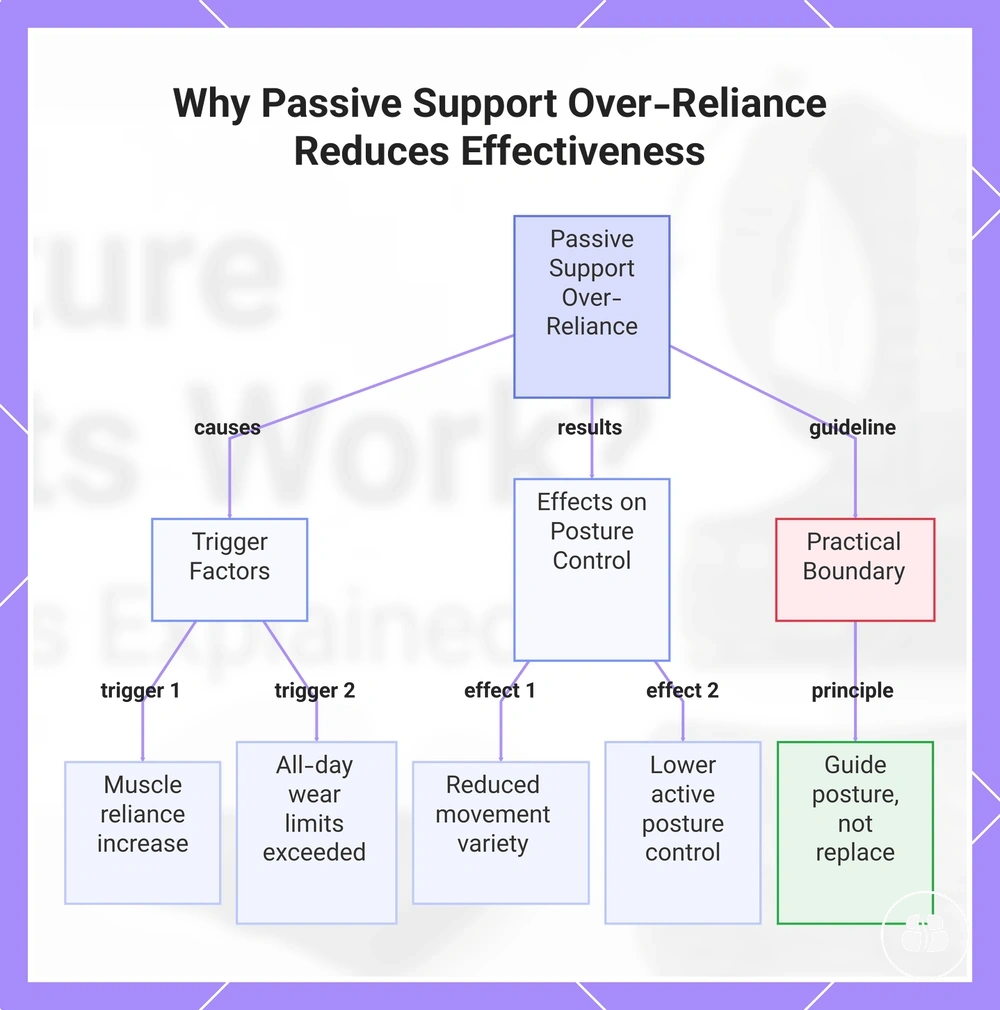
Passive support can reduce effectiveness for posture support accessories when it begins to replace active posture control instead of assisting it, especially as muscle reliance increases. This limitation becomes more noticeable when all-day wear limits are exceeded or when usage behavior shifts from supportive use to continuous dependency. In such cases, the balance between passive support and active posture control can weaken, affecting overall posture behavior outcomes. :contentReference[oaicite:0]{index=0}
As support duration increases, the interaction between passive support and muscle engagement may change, often reducing movement variety and lowering active posture control. User dependence can grow when the body relies more on external support than internal adjustment, which may limit natural muscle engagement over time. These factors vary by usage behavior and do not produce fixed outcomes, but they can influence how effectively the accessory continues to assist posture rather than replace it.
Passive support should function as an assistive element that supports posture behavior rather than replacing active posture control entirely. When reliance becomes too high or all-day wear limits are not respected in practical use patterns, the system may shift toward reduced muscle engagement and lower movement variety. A practical boundary is that support should guide posture, not fully substitute natural control.
This chart shows the triggers of passive support over-reliance, its effects on posture control, and the practical boundary for safe use.
Pain, medical conditions, and structural posture changes
Pain, medical conditions, and structural posture changes require cautious interpretation of posture support accessory effectiveness because these factors can significantly alter how outcomes are understood in real use. Pain persistence, numbness, injury history, spinal conditions, and visible structural posture changes introduce uncertainty that may make accessory response difficult to evaluate without professional assessment. These conditions should be treated as safety-relevant variables rather than direct indicators of effectiveness.
When these conditions appear, distinguishing between poor fit, wrong use, and underlying medical uncertainty becomes important. Discomfort may sometimes relate to usage mismatch, but it can also coincide with broader structural or medical conditions that require careful interpretation. Because of this overlap, accessory effects should not be interpreted in isolation when pain or structural changes are present, and cautious interpretation remains necessary.
To support safe interpretation, the following conditions require careful attention and possible professional assessment:
- Pain persistence that does not clearly relate to usage context
- Numbness or recurring discomfort during or after use
- Injury history affecting posture or movement patterns
- Spinal conditions influencing structural alignment
- Visible structural posture changes requiring careful evaluation
- Situations where professional assessment may be needed for clarity
What the evidence says about posture support accessories
Evidence about posture support accessories is generally more suitable for explaining immediate support effects such as alignment cues and comfort perception than for supporting strong claims about lasting posture correction. In most cases, research and outcome data reflect short-term effects rather than universal long-term structural change, so interpretation must stay within evidence scope and outcome measured boundaries. :contentReference[oaicite:0]{index=0}
User reviews, comfort reports, and clinical outcomes represent different evidence classes and should not be treated as a single unified measure of effectiveness. User reviews typically reflect subjective comfort and perceived support, while comfort reports capture immediate experience during use, and clinical outcomes focus on structured evaluation under controlled conditions. These differences matter because each evidence class reflects a different certainty level and outcome measured context, which prevents direct comparison without interpretation.
Interpretation of evidence depends strongly on device type, use pattern, study context, and user condition, since these variables influence how results appear in real-world use. Short-term use often highlights immediate support effects, while different user conditions can shift perceived alignment or comfort outcomes. As a result, certainty level remains variable and should be assessed based on context rather than assumed as uniform across all accessories.
To organize how posture support accessories are evaluated, the following table summarizes key evidence dimensions and interpretation factors:
| Outcome measured | Device type | Use pattern | Study context | User condition | Certainty level |
|---|---|---|---|---|---|
| Immediate support effects vs long-term outcomes | Support accessory category and design variation | Short-term or repeated usage patterns | User reports or structured evaluation settings | Posture condition and individual variability | Context-dependent evidence strength |
Posture support accessories hub
Immediate alignment effects versus long-term outcome evidence
Immediate alignment effects are easier to observe than long-term outcome evidence because measurement timing captures short-term posture positioning changes more directly than extended behavioral or structural adaptation. These effects are typically assessed during active use, while long-term interpretation depends on carryover observation beyond the usage period, which increases uncertainty in certainty level and evidence interpretation. :contentReference[oaicite:0]{index=0}
Before-and-after posture comparison alone does not represent lasting outcome evidence, because a visible change in posture position during use may reflect immediate alignment support rather than sustained behavior change. In many cases, carryover and behavior change cannot be confirmed from short observation windows, making the interpretation dependent on time horizon and user condition. This creates a limitation where observed effect does not automatically translate into long-term outcome evidence.
To clarify how interpretation shifts across time horizon, the comparison below separates immediate alignment effects from long-term outcome evidence:
| Time horizon | What can be observed | What remains uncertain |
|---|---|---|
| Immediate use period | Short-term alignment and observed effect during support use | Whether posture returns or changes persist after removal |
| Repeated use | Consistent short-term alignment effects across sessions | Strength of carryover and behavior change without support |
| Long-term | Potential adaptation patterns in posture behavior | Stability of lasting outcome evidence over time |
Why evidence differs by device type, use pattern, and user condition
Evidence differs by device type, use pattern, and user condition because device category, support location, stiffness, wear duration, adjustment quality, baseline posture issue, and user activity all influence how outcomes appear during use. These variables change how immediate alignment effects are produced and how they are interpreted, which leads to evidence variation across different real-world situations.
Device type affects how support location and stiffness interact with posture, while wear duration and adjustment quality influence how consistent the observed effect remains during use. In some cases, shorter wear duration may only reflect temporary alignment, while inconsistent adjustment quality can reduce clarity in measurement timing and observed effect. Baseline posture issue and user activity further shape how the response appears, making outcomes dependent on user condition rather than a single fixed pattern.
Because these factors vary together, mixed evidence does not support universal claims across all posture support accessories. Instead, it shows that interpretation depends on matching evidence to device type, use pattern, and user condition, without extending conclusions beyond their specific context.
- Device type influences support location and stiffness behavior
- Use pattern affects consistency of observed effect
- User condition shapes baseline posture issue and response level
- Support location changes how alignment is distributed
- Stiffness impacts comfort and alignment intensity
- Wear duration affects carryover stability of results
- Adjustment quality determines reliability of support effect
- User activity modifies how posture responds during use
How to judge whether a posture support accessory is helping
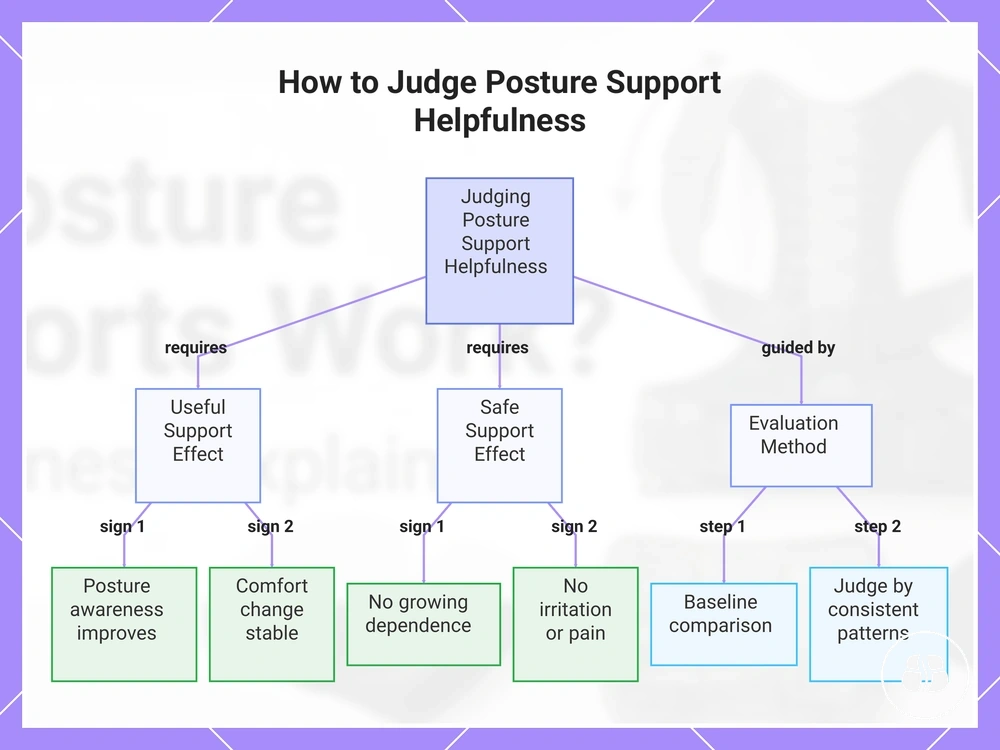
Judging whether a posture support accessory is helping depends on whether it produces a useful support effect and a safe support effect while maintaining comfort, posture awareness, and the absence of warning signs. This judgment should combine how the body feels during use with whether function remains stable and no negative signals emerge, forming a clear evaluation frame for ongoing use.
The before-use baseline is the reference point for comparison, since posture awareness, comfort change, movement tolerance, dependence, irritation, pain response, and carryover must be assessed against how the body behaves without support. If posture awareness improves and comfort change stays stable while movement tolerance is maintained, a useful support effect may be present. However, if dependence increases or irritation and pain response appear, the safe support effect may be reduced and the interpretation should be adjusted accordingly.
When signals are mixed, the situation should be reassessed rather than assumed as either fully positive or negative. In such cases, decisions may include continuing cautiously, adjusting expectations, stopping use, or seeking professional advice depending on how irritation, pain response, and carryover evolve over time. The key is to judge based on consistent patterns rather than isolated moments of comfort or discomfort.
Mini-checklist for evaluation:
- Before-use baseline is clearly understood for comparison
- Posture awareness improves during regular use
- Comfort change remains stable without increasing discomfort
- Movement tolerance is not significantly reduced
- No growing dependence on external support is observed
- Irritation does not appear or worsen during use
- Pain response remains absent or does not increase
- Carryover after removal is neutral or consistent
This chart shows the key evaluation criteria and steps for determining whether a posture support accessory is providing useful and safe support.
Useful signs during sitting, standing, or daily wear
Useful signs during sitting, standing, or daily wear are practical support signals that may indicate a posture support accessory is helping through improved posture awareness and comfort. These signs should always be interpreted against the baseline rather than in isolation, since they reflect normal-use response patterns rather than proof of permanent change.
- Sitting shows increased upright awareness compared to baseline during normal posture use
- Standing shows reduced slouching prompts during routine movement and posture shifts
- Daily wear maintains comfort without restriction across normal activities and movement patterns
- Easier position correction occurs when moving from slouched to more neutral posture positions
- No new discomfort appears during sitting, standing, or extended daily wear conditions
- Baseline comparison confirms whether useful signs differ meaningfully from before-use posture behavior
Signs the accessory is not the right support approach
Signs the accessory is not the right support approach are warning signs that indicate the accessory may not be the right support approach and should lead to stop signal, adjustment, or reassess decisions. These warning signs include increased pain, numbness, restricted breathing, restricted movement, skin irritation, poor fit, dependence, or no meaningful awareness improvement, and they should be interpreted as safety signals rather than normal response patterns. :contentReference[oaicite:0]{index=0}
When these negative signs appear, the cause may be either an adjustment issue such as poor fit or an unsuitable support approach that does not match the user’s condition. Poor fit may sometimes be improved through correction, but a fundamentally unsuitable support approach can continue producing warning signs even after adjustments. In both cases, reassess decisions should rely on repeated patterns of discomfort or limitation rather than isolated incidents.
- Increased pain during sitting, standing, or daily wear
- Numbness or tingling that persists during or after use
- Restricted breathing or restricted movement during normal activity
- Skin irritation developing or worsening with continued use
- Poor fit that does not improve with basic adjustment
- Growing dependence without improved posture awareness
- No meaningful awareness improvement compared to baseline
- Need to reassess use when multiple warning signs occur together